
In the construction world, winning a bid isn't just about coming in with the lowest price. It's a high-stakes race where speed, accuracy, and ironclad compliance determine who comes out on top. Construction proposal software is your command center for this race, transforming a chaotic manual process into a focused, strategic operation. It’s the difference between drowning in paperwork and submitting smarter, more profitable bids with complete confidence.
Winning Bids in a High-Stakes Industry
A construction proposal is more than a quote—it's a promise. It’s your firm's handshake, assuring a client you can deliver a complex project on time and on budget. But for too many contractors, this critical first step is a frantic scramble of disjointed spreadsheets, scattered documents, and endless manual data entry.
That old-school approach is loaded with risk. A single misplaced decimal point in an Excel sheet can wipe out your profit margin. Overlooking a compliance clause buried in a 300-page Request for Proposal (RFP) can get your bid disqualified. Every hour your team spends manually cross-referencing specs and safety requirements is an hour they aren't spending on strategy.
From Manual Chaos to Strategic Advantage
This is where dedicated construction proposal software gives you a serious leg up. Think of it as an automated pre-construction assistant. Its core job is to bring order to the chaos by pulling every piece of the bidding process into one central hub.
Instead of your team hunting for information across dozens of disconnected files, everyone works from a single source of truth. This simple shift drastically cuts down on human error and ensures the whole team is working with the most current data. The result is a faster, more reliable workflow that frees up your estimators and proposal managers to focus on what actually wins the job: crafting a compelling bid.
Before we dive into the specifics, let's look at how this software fundamentally changes the game.
Traditional vs. Software-Driven Proposal Workflow
Proposal Stage | Traditional Method (Manual) | With Proposal Software (Automated) |
RFP Analysis | Reading hundreds of pages manually; high risk of missing key requirements. | AI-powered analysis instantly flags risks, clauses, and key deadlines. |
Cost Estimation | Manual data entry into spreadsheets; version control issues are common. | Centralized cost libraries and templates ensure consistency and accuracy. |
Compliance & Safety | Manually creating and attaching JHA/JSA documents for each bid. | Automated generation of safety plans based on project scope. |
Review & Approval | Emailing document versions back and forth; slow and prone to error. | In-app workflows with clear tracking and accountability for approvals. |
Final Submission | Compiling various documents into a single PDF; last-minute rush. | One-click export to a professional, branded, and complete proposal package. |
The contrast is clear. Automation doesn't just make the process faster; it makes it smarter and safer at every step.
The Growing Need for Digital Solutions
The industry's shift to digital tools isn't just a fleeting trend—it’s a fundamental change in how business gets done. The global construction software market, valued at around USD 5.36 billion in 2025, is expected to nearly double to USD 10.05 billion by 2032. This explosion is fueled by the growing complexity of modern projects, driven by urbanization and the rise of smart cities. You can explore a full market analysis on CoherentMI.com for a deeper dive.
A well-crafted proposal is your first, and often best, opportunity to build trust with a potential client. Automating the tedious, error-prone tasks allows your team to dedicate their expertise to demonstrating value, not just calculating costs.
This strategic automation has a direct impact on your bottom line. To significantly accelerate the bidding process and ensure timely submissions, consider leveraging document workflow software to close deals faster. By automating tedious tasks like RFP analysis and compliance checks, you give your team the crucial competitive advantage needed to win more profitable work.
Core Features That Drive Proposal Success
Good construction proposal software is more than a digital filing cabinet. It’s an intelligent system built to give you a competitive edge by handling the detail-heavy work that used to bog down your best people. These core features are the engine that powers smarter, faster, and more accurate bidding.
Instead of just listing functions, let's look at the real-world impact of the tools that matter. These features separate a simple document builder from a true proposal automation platform. They work together to cut your risk, lock in compliance, and free up your team to focus on strategy.
The diagram below shows exactly how this technology untangles a messy, manual workflow and turns it into a clear path toward winning more bids.
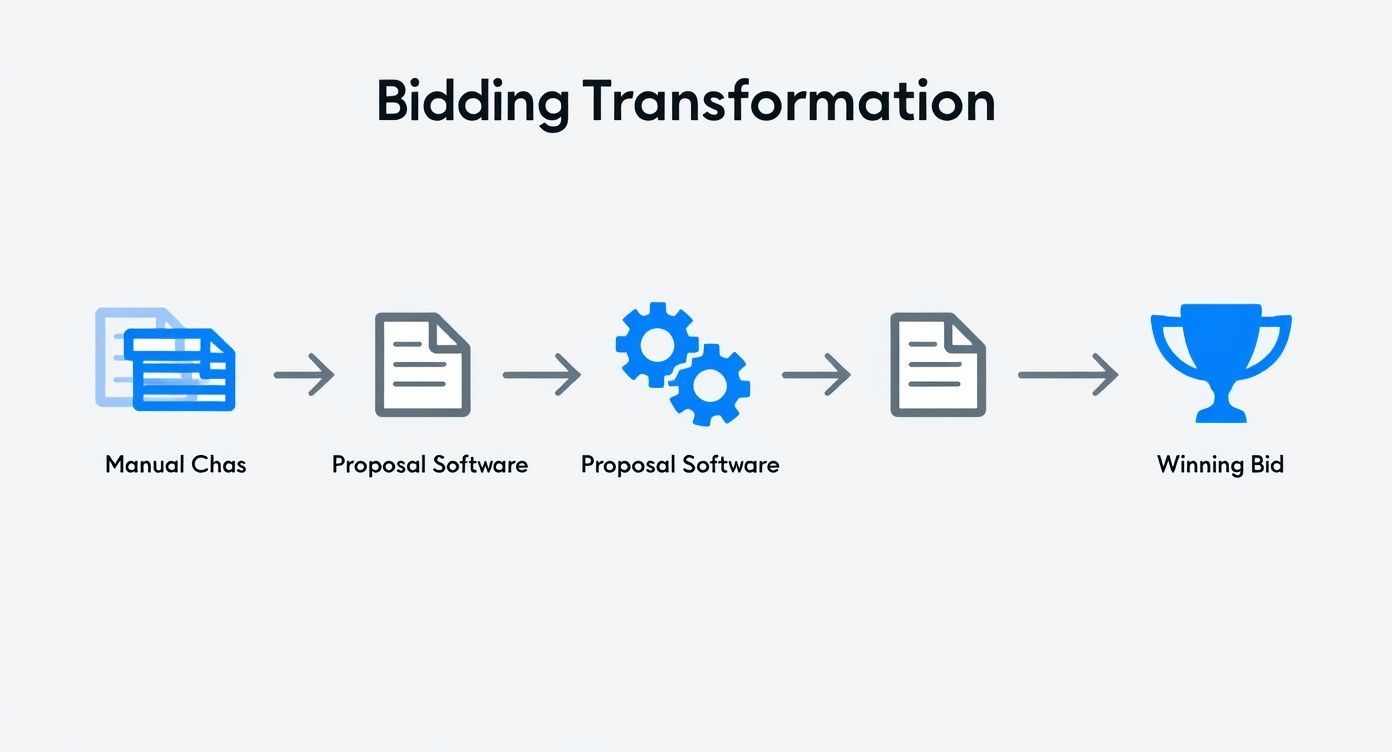
This visual captures the jump from disorganized chaos to a structured, software-driven process. Now, let’s dig into the specific features that make it happen.
AI-Powered RFP and Specification Analysis
Imagine a 400-page Request for Proposal (RFP) lands on your desk, and it's due Friday. Going through that document manually isn't just slow—it's a minefield. One missed requirement can get your entire bid disqualified or lead to a costly change order after you've won the job.
Modern proposal software uses AI to act as a tireless analyst. It can review hundreds of pages in minutes, extracting the critical details you can't afford to miss.
- Actionable Insight: Upload your RFP to the software. Within minutes, the AI will highlight every contractual obligation ("must," "shall," "will").
- Risk Identification: The system flags risky clauses—like penalties, unusual liabilities, or steep insurance requirements—so your team can address them head-on.
- Submittal Registers: The software automatically generates a complete list of all required submittals and their due dates. This gives you the backbone of your compliance plan from day one.
This automated analysis means your team spends less time reading and more time strategizing on how to deliver a winning proposal.
Automated Compliance and Clause Coverage
Ensuring your proposal ticks every box in an RFP is one of the most stressful parts of bidding. A compliance matrix—the checklist mapping your responses to the client's requirements—is non-negotiable, but building one by hand is a tedious grind where mistakes are common.
A core function of advanced proposal software is to guarantee 100% clause coverage. It creates a verifiable link between every requirement in the RFP and the corresponding section of your proposal, leaving no room for doubt.
This feature provides an audit-proof record that proves your bid is fully compliant. It’s a powerful way to build a client’s trust and protect your firm from future disputes. Advanced platforms like NextBid.ai are built to deliver this level of traceability, turning complex specifications into solid, bid-ready evidence.
JHA and JSA Generation
Safety is paramount. A comprehensive Job Hazard Analysis (JHA) or Job Safety Analysis (JSA) is standard for most construction bids, but creating these from scratch for every proposal is a massive time sink. It often pulls your busiest safety and operations managers away from other critical work.
The best proposal software automates this step. By analyzing the project scope from the RFP, the system can:
- Identify Project-Specific Tasks: It recognizes the work involved, whether it's excavation, steel erection, or concrete pouring.
- Map Hazards and Controls: The software cross-references tasks with a built-in library of common hazards and maps them to the right OSHA or WHS control measures.
- Generate Draft Documents: It produces a detailed, site-specific JHA/JSA. Your safety manager can then review and finalize it in a fraction of the time, rather than starting from a blank page.
This automation not only saves dozens of hours but also ensures your safety documentation is consistent and up-to-date with the latest standards on every single bid.
Traceability and Secure Audit Trails
What happens when a client questions a decision six months into a project? Without a clean record, you’re stuck digging through old emails and meeting notes. A solid audit trail is your best defense.
Top-tier proposal software creates an unchangeable record of every action taken during the bid. You can see who reviewed which clause, what comments they made, and when they gave their approval. This complete traceability gives you a bulletproof defense against claims and simplifies internal quality control.
Better yet, features like one-click export to common formats like DOCX or CSV ensure this invaluable data is always at your fingertips for reports and analysis.
How to Select the Right Proposal Software
Choosing the right construction proposal software can completely change your bidding game. The right tool sharpens your competitive edge, while the wrong one just adds another layer of complexity.
The secret isn't just comparing feature lists; it's matching technology to how your team actually works. Before scheduling demos, audit your current process. Identify where things grind to a halt and which parts of proposal building consume the most hours or introduce the biggest risks. That's your starting point.
Define Your Core Needs and Priorities
Before you start browsing vendor websites, create a checklist of your absolute must-haves. Are you constantly wrestling with complex government RFPs that demand meticulous compliance tracking? Or is your main headache simply getting consistent, professional-looking proposals out the door quickly?
To make the right choice, get specific:
- Company Size and Type: A large GC bidding on eight-figure projects needs robust risk analysis and deep audit trails. A specialty subcontractor might prioritize speed and a library of ready-to-go templates.
- Integration Capabilities: Ensure the software connects seamlessly with your estimating tools, CRM, or ERP. Without this, you're stuck with manual data entry—the very problem you're trying to eliminate.
- User Experience (UX): This is non-negotiable. If the software is clunky or unintuitive, your team won't use it. During a demo, ask to see the end-to-end workflow for a typical proposal to gauge its usability.
Getting this self-assessment right is the most critical part of the process. It becomes the lens through which you'll judge every option.
Evaluate Vendor Support and Security
The software itself is only half the story. The company behind it is just as important. A responsive and knowledgeable support team is invaluable, especially during the initial setup. Look for vendors who offer solid training materials, clear documentation, and a support team you can easily reach.
When you invest in software, you're not just buying a tool—you're entering into a partnership. A strong vendor relationship ensures you have the support needed to adapt the platform as your business grows and your needs change.
Don't overlook data security. Your proposals contain sensitive client details and financial data. Any vendor you consider must have top-tier security credentials, like SOC 2 or ISO 27001 compliance, to ensure your information is protected.
You can often get a sense of a company's commitment by how transparent they are. Check for clear policies on security and straightforward cost breakdowns, like the one you can find in NextBid.ai's pricing information.
On-Premise vs Cloud-Based Deployment Models
Finally, you have a big decision to make: do you want a traditional on-premise installation or a modern, cloud-based (SaaS) solution? These days, the vast majority of new platforms are cloud-based, and for good reason. They offer more flexibility, lower upfront investment, and you never have to worry about updates.
This shift to the cloud is happening across the board. The construction estimating software market, a close cousin to proposal software, was valued at USD 42.45 billion in 2024 and is expected to climb to USD 65.53 billion by 2032. That explosive growth is driven by the industry’s demand for accessible, real-time, and collaborative tools. You can discover more insights about this market growth.
To help you weigh the options, here’s a quick breakdown of how the two models stack up.
Software Deployment Model Comparison
Factor | On-Premise Software | Cloud-Based (SaaS) Software |
Initial Cost | High upfront investment for licenses and hardware. | Lower initial cost with a monthly or annual subscription. |
Maintenance | Your internal IT team is responsible for all updates and maintenance. | The vendor manages all updates, security patches, and maintenance. |
Accessibility | Limited to on-site or VPN access, making remote work difficult. | Accessible from anywhere with an internet connection. |
Scalability | Scaling requires purchasing additional licenses and server capacity. | Easily scalable; you can add or remove users as your team changes. |
Ultimately, the choice depends on your IT resources and how your team needs to work. But for most modern construction firms, the flexibility and predictability of a SaaS model are hard to beat.
Implementing Your New Proposal System
Successfully implementing new software is a project in people and process, not just technology. A successful launch requires a strategic plan to turn that investment into an operational advantage that your whole team actually wants to use.
Your first step is to build a business case that connects the software to tangible results. This isn't about listing features; it's about showing how it will make everyone’s job easier and the company more profitable.
Calculating Your Return on Investment
To get buy-in, you must speak in terms of results. Frame the investment by calculating its potential ROI, focusing on where your manual processes are costing you time, money, and opportunities.
- Actionable Insight: Track the hours your team spends on each proposal. Calculate the labor cost savings if software could cut that time by 30-50%. Frame this as the ability to submit more bids without increasing headcount.
- Cost of Errors Avoided: Identify a past bid that was lost due to a compliance error or miscalculation. Quantify the potential profit lost. Use this as a concrete example of the financial risk the software mitigates.
- Improved Win Rates: Model the revenue impact of increasing your win rate by just 1% or 2%. If automation lets your team submit 10% more high-quality bids, what’s the potential return on that extra volume?
Presenting this data transforms the discussion from a new expense into a strategic investment in growth and profitability.
Managing Change and Driving Adoption
The biggest hurdle for any new system is often old habits. The key to overcoming resistance is clear communication and involving your team from the beginning. Their buy-in is essential for a smooth rollout.
A phased rollout is almost always the smartest play. Instead of disrupting the entire company at once, pilot the software with a single project or a small, enthusiastic team. This approach creates internal champions who can share their wins and help train their colleagues.
This strategy minimizes disruption and lets you work out any kinks in a controlled setting. Once the pilot team demonstrates success, getting everyone else on board becomes much easier because it’s backed by proven results. Secure processes are crucial, and you can learn more about what robust security for construction data involves to make sure your plan is airtight.
The Role of Comprehensive Training
Powerful software is useless if nobody knows how to use it. Don't skimp on training. A well-trained team is a confident team, and confidence leads to high adoption rates.
Tailor your training plan to be practical and role-specific:
- Estimators: Focus on how to import cost libraries and pull takeoff data directly into proposals.
- Proposal Managers: Train them on generating compliance matrices and managing approval workflows.
- Safety Managers: Show them how to use the automated JHA/JSA generation features.
- Leadership: Provide a tour of the dashboards for tracking bid progress and win/loss analytics.
By making the training directly relevant to each person's daily tasks, you create a clear link between the tool and its value. This targeted approach ensures your new system gets woven into the fabric of how you win work.
Real-World Examples of Proposal Automation
It’s one thing to talk about features, but it’s another to see how proposal software works in the real world. This isn't just about creating documents faster; it’s about changing how your company handles risk, meets compliance, and ultimately grows.
Let's walk through a few scenarios that show what this technology can do.
These stories show how the right tools deliver real ROI—better efficiency, smarter risk management, and more profit. To see the bigger picture, it helps to understand the broader concepts of automation that make these tools possible.
The General Contractor Tackling Government RFPs
A mid-sized GC is trying to land a major government infrastructure project. The RFP is a 500-page monster packed with dense legal clauses and strict safety mandates. Manually, this would take their lead estimator and a proposal manager a full week just to review and flag key items.
With construction proposal software, their week looks completely different.
- Instant Analysis: They upload the RFP. In about an hour, the AI analyzes the entire document, flagging every contractual obligation, pinpointing high-risk liability clauses, and generating a complete submittal checklist with deadlines.
- Compliance Assurance: The system builds a compliance matrix that maps every RFP requirement to a specific section in their proposal, guaranteeing 100% clause coverage.
- Strategic Focus: Instead of being bogged down in manual review, the team immediately begins strategizing. They use the risk report to fine-tune their pricing and the flagged opportunities to highlight their competitive advantages. They submit a smarter, more competitive bid in half the time.
The Subcontractor Scaling Up Bids
A specialized electrical subcontractor with a lean office team has the field expertise to take on more work, but their manual bidding process is a bottleneck. They struggle to produce more than two or three quality bids a week.
By implementing proposal software with strong templating, they systemized their workflow.
This simple change allowed their small team to double its output, sending out six to eight professional bids every week without adding headcount. The consistency improved their brand's professionalism and helped them win more of the jobs they really wanted.
The Engineering Firm Bulletproofing Its Audit Trail
An engineering firm designs and consults on large civil projects. For them, the biggest risk isn't on the job site—it's buried in the paperwork. A disputed design spec or an unrecorded client approval could lead to a massive liability claim.
They use their software's traceability features to build an ironclad audit trail. Every comment, revision, and sign-off on a proposal is automatically logged with a timestamp and user ID. When a client questions a design detail six months later, the firm can instantly pull records showing the exact clause, the internal discussion, and the client’s formal approval. What could have been a costly legal battle becomes a quick, five-minute clarification.
So, What's Your Next Move?
It's time to stop reacting and start strategizing. Moving away from manual bidding isn't just about a new tool; it’s about adopting a smarter way of working. The right construction proposal software systematically removes bottlenecks, reduces costly human errors, and frees up your best people to focus on winning the right projects.
This isn't just about "going digital." It’s about specific upgrades to your entire pre-construction workflow. The rise of specialized tools like construction punch list software, a niche expected to grow from USD 665.1 million in 2025 to USD 1.5 billion by 2035, shows the industry's demand for focused digital solutions that solve real-world problems, a trend covered in this in-depth market analysis.
A Clear Path Forward
Feeling ready to modernize your workflow is one thing. Doing it requires a plan. Don't try to change everything at once. Instead, take these deliberate steps to get started on the right foot.
Here’s a simple, three-step action plan:
- Pinpoint Your Pain: Before you look at any software, audit your current process. Where do bids get stuck? Is it deciphering the RFP, endless compliance checks, or the final rush to compile everything? Identify your top three bottlenecks—these are your evaluation criteria.
- Request Targeted Demos: Don't sit through generic product tours. Contact vendors, present them with your specific bottlenecks, and say, "Show me exactly how your platform solves this." Seeing a feature demonstrated in the context of your own daily challenges makes its value clear.
- Run a Live Trial: The only way to know for sure is to put the software to the test. Take a recent bid—or a live one—and run it through a trial. Nothing beats hands-on experience for seeing the real impact on your team’s speed and the quality of your final proposal.
Platforms like NextBid.ai were built to tackle these core challenges head-on, transforming tedious document reviews into a simple, audit-proof process. By taking these concrete steps, you can finally stop drowning in paperwork and start submitting smarter, more competitive bids. The future of your bidding process starts now.
Answering Your Top Questions
Getting into construction proposal software brings up a lot of practical questions. Let's tackle some of the most common ones head-on so you can feel confident about your next steps.
How Much Should I Expect to Pay?
The price can vary widely based on the number of users, features, and deployment model. Most modern platforms are subscription-based, ranging from a few hundred to several thousand dollars per month.
However, the real conversation isn't about cost, but about ROI. Actionable Insight: Calculate the cost of one lost bid due to a compliance error. Compare that figure to the annual software subscription cost. Winning just one extra bid a year could easily pay for the software. Always ask for a custom quote based on your specific needs.
Will This Software Work With My Estimating Tools?
It must. If a platform doesn't integrate with your existing tools, it's not the right choice. Solid construction proposal software is built to connect with common systems like Procore, Autodesk Construction Cloud, and your company's ERP.
This integration allows cost data and project details to flow directly into your proposal, eliminating manual data entry and reducing the risk of errors. Before committing, confirm that the platform has ready-made integrations for your specific tools.
How Long Will It Take to Get My Team Up and Running?
This depends on your team's size and tech-savviness, but modern cloud software has made implementation much faster. Basic setup and configuration can often be completed in a few days.
The key to a fast and successful launch is user adoption, which hinges on good training. A platform with a clean, intuitive layout may only require a few hours of role-specific training. A good software partner will provide a clear onboarding process with tutorials and live support to help your team get up to speed quickly.
Ready to turn your bidding process from a time-sucking chore into your biggest competitive advantage? Halozen gives you an AI-powered assistant that turns dense RFPs into audit-proof, bid-ready evidence in a matter of hours. Discover how NextBid.ai can help you win more profitable bids with less risk.