
The Death of "Gut Feel"
In high-stakes preconstruction, a "pretty sure" estimate is a gamble you can no longer afford. Every new RFP is a hundred-page minefield of buried clauses, obscure safety mandates, and aggressive penalty terms.
For years, the industry has relied on the "manual grind": senior estimators armed with highlighters and spreadsheets, trying to catch every detail under crushing deadlines. But when your team is sifting through 150+ bids a year, manual review becomes the single greatest point of unmanaged risk.
The ROI of Precision: Modern estimating teams are reclaiming 23.5 hours per bid and achieving 95%+ clause coverage by shifting from document hunting to AI-driven deconstruction.
The Manual Bottleneck in Modern Preconstruction
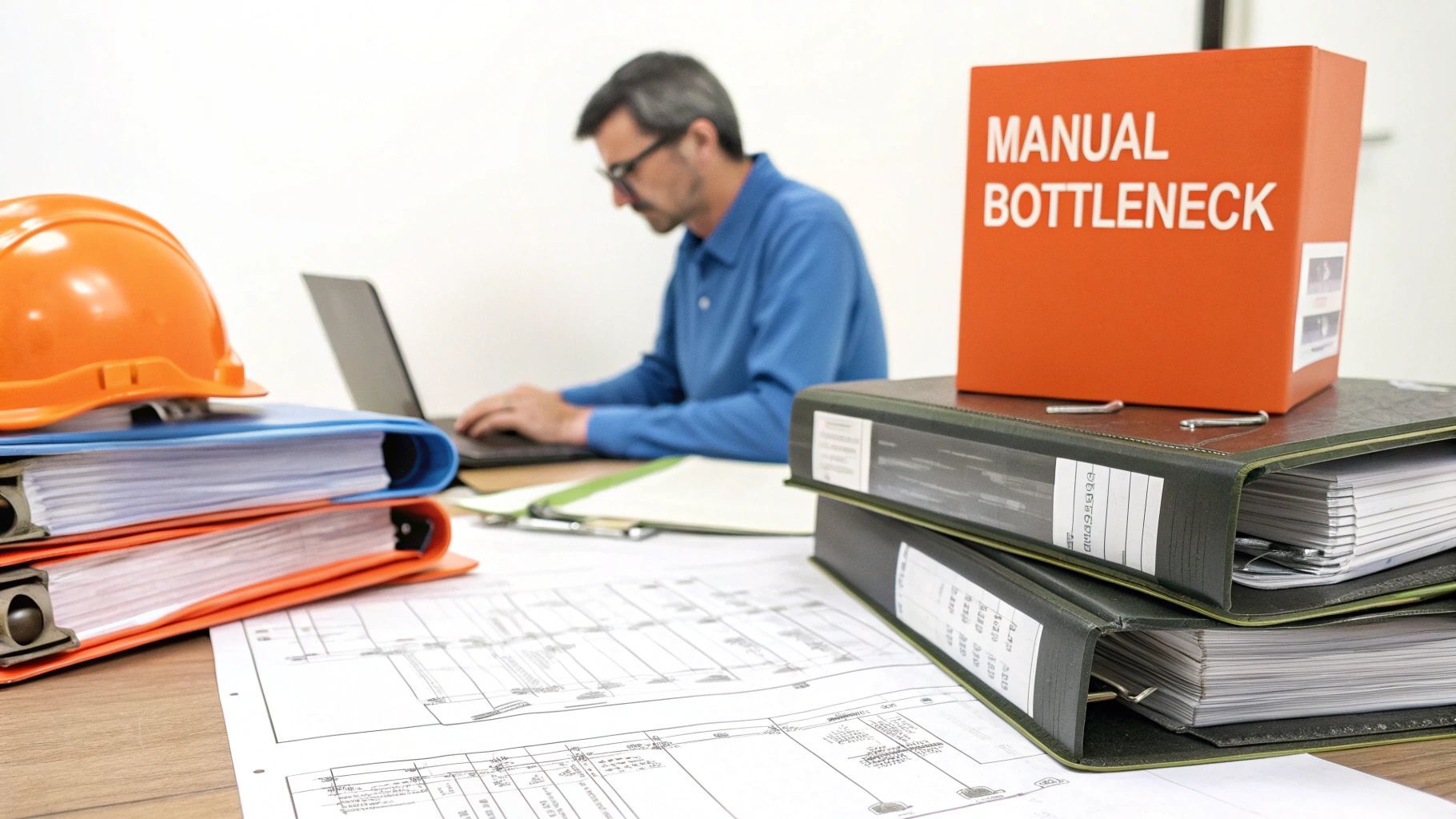
Does your team feel like they’re drowning in RFPs? It’s a common story. For most preconstruction teams, bidding is a high-stakes, manual grind that’s inefficient and full of risk. Estimators face a constant flood of documents—often hundreds of pages packed with dense legal jargon, technical specs, and requirements hidden in the fine print. This creates a massive bottleneck right at the very start of a project.
The heart of the issue is the sheer volume of manual labor. Teams burn most of their time on repetitive, low-impact tasks instead of focusing on high-level strategy that actually wins bids.
The Daily Grind of Clause Hunting
Estimators burn 80% of their time on repetitive, low-impact tasks:
- The Search: Line-by-line hunts for liquidated damages or unusual insurance riders.
- The Safety Gap: Manually digging out hazards to build a Job Hazard Analysis (JHA).
- The Cost: One missed requirement in a 200-page spec can be the difference between a profitable project and a costly mistake.
When your best talent is buried in paperwork, they can’t focus on Strategic Pricing, Value Engineering, or Relationship Building.
A single missed requirement in a 200-page specification document can be the difference between a profitable project and a costly mistake. This manual review process is the single greatest point of unmanaged risk in preconstruction.
How AI Works as Your Preconstruction Copilot
To really get what AI in construction estimating brings to the table, don't think of it as some mysterious black box. it’s a tireless assistant built to amplify what your estimators do best. By using three core technologies, it turns a week-long marathon into a 72-hour sprint.
- The Super-Paralegal (NLP): Scans thousands of pages in minutes to flag hidden contractual risks and penalties.
- The Meticulous Quantity Surveyor (Computer Vision): Automates quantity takeoffs from 2D plans, eliminating counting errors and slashing takeoff time by up to 80%.
- The Risk Analyst (Machine Learning): Analyzes historical project data to predict cost overruns before you even submit the bid.
Traditional Estimating vs An AI-Powered Workflow
The table below breaks down the dramatic shift in time, effort, and outcomes when moving from a manual process to an AI-augmented one for key preconstruction tasks.
Preconstruction Task | Traditional Manual Workflow | AI-Powered Workflow & Outcome |
Document Review | 23.5 hours of manually reading every page to find key clauses, risks, and requirements. High chance of human error. | <1 hour for automated scanning and extraction. The AI flags all critical information with 95%+ clause coverage, linking each item back to its source. |
Scope Identification | Manually combing through spec books and drawings to piece together scopes of work. Slow and prone to omissions. | The AI automatically identifies and categorizes all scopes of work from the documents, creating a comprehensive list in minutes. |
Subcontractor Pricing | Sending out entire bid packages to all subs, leading to confusion and unqualified bids. | The AI generates targeted bid packages with only the relevant documents for each trade, resulting in faster, more accurate quotes from qualified subs. |
Takeoffs & Measurement | Days or weeks of manual counting and measuring from 2D plans. Repetitive, tedious, and subject to mistakes. | Automated quantity takeoffs are completed in minutes or hours. This delivers precise quantities and frees up estimators for higher-value analysis. |
Risk Assessment | Relies on individual experience and memory. Key risks can be easily missed, especially with new or complex project types. | The AI proactively identifies and flags contractual, financial, and safety risks based on a comprehensive analysis of all documents against historical data. |
JHA/JSA Generation | Creating safety plans from scratch for each project, a time-consuming and often overlooked step in pre-bid. | A preliminary JHA is automatically generated based on the identified scopes of work, ensuring safety is considered from day one. |
Ultimately, the contrast is clear. The AI workflow doesn't just make the old process faster; it fundamentally changes the nature of the work, elevating estimators from data miners to strategic decision-makers.
Turning an RFP into a Bid in Under 72 Hours
A 200-page RFP lands in your inbox. The clock starts ticking. For most estimators, this kicks off a week-long scramble of manual clause hunting, where the team painstakingly searches for every hidden risk, obscure requirement, and safety compliance issue buried in the documents. It’s a high-stakes, high-stress grind where one missed detail can blow up your profit margin.
But what if you could compress that entire week-long marathon into a focused, 72-hour strategic sprint? This is exactly what’s possible with purpose-built AI in construction estimating. Instead of drowning in documents, your team can confidently chase more bids with far less risk.
From Document Ingestion to Actionable Intelligence
The moment you upload the project files, the AI platform goes to work. This isn’t just a fancy keyword search; it’s a deep, contextual analysis of every single page, from the specs to the legal clauses. Within hours, it starts churning out clear, actionable outputs that completely reshape your preconstruction workflow.
Think about the 23.5 hours usually lost on that initial document review. The AI handles it in a fraction of that time, nearly eliminating the human errors that creep in from fatigue and oversight. It takes a mountain of unstructured data and turns it into a structured, organized toolkit for building a winning bid.
The AI doesn’t just find information; it organizes it for action. By the time your team grabs their morning coffee, they have a complete, digestible summary of every critical element in the bid package. They can skip the manual search and jump straight into strategy.
This process shifts your team’s focus from tedious data handling to the high-level analysis that actually wins projects.
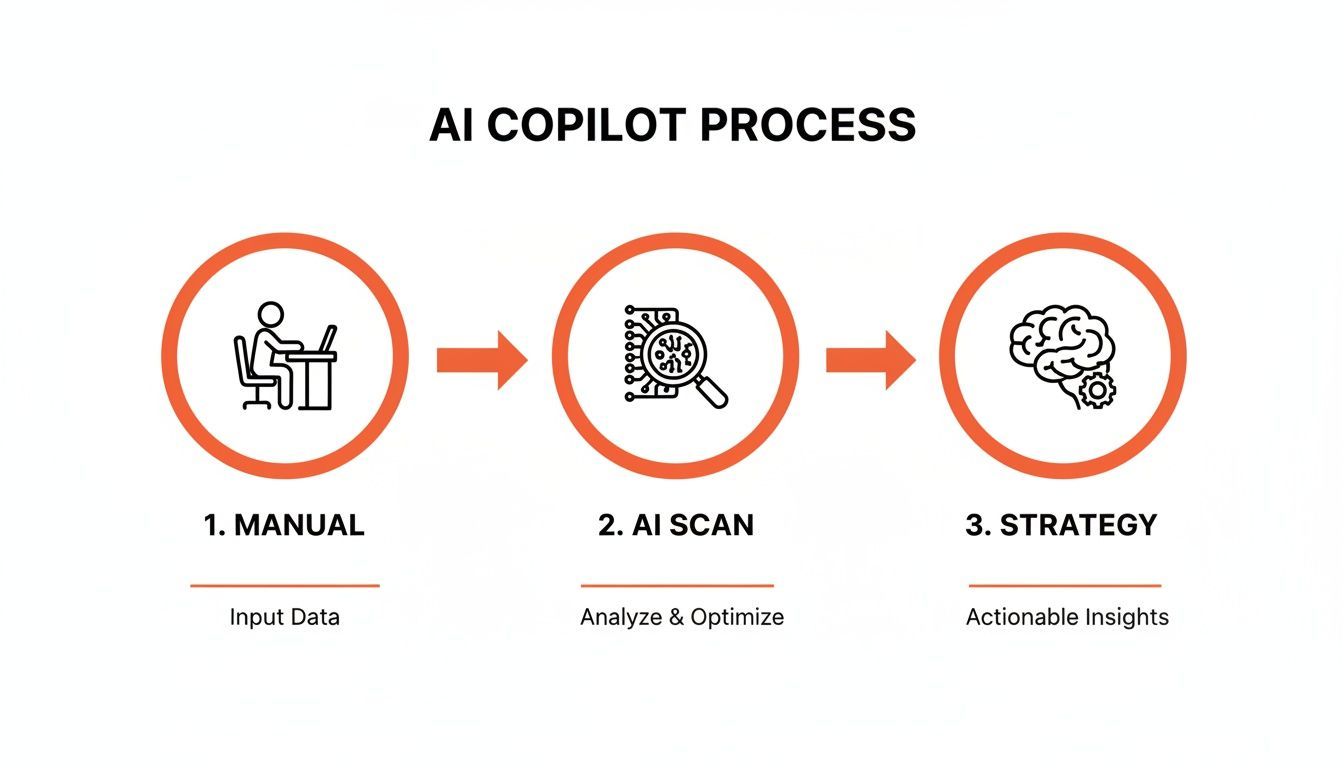
The key takeaway is simple: human effort is better spent on high-value strategic planning, not mind-numbing data extraction.
The Power of Cited, Auditable Outputs
Speed is great, but the real game-changer is the reliability. Every piece of information the AI extracts is cited, linking directly back to the source document, page, and even the line number. This creates an unbreakable audit trail, giving your team total confidence in their bid.
Here’s what that looks like in the real world:
- A comprehensive clause register: You get a detailed list of every contractual requirement, penalty, and key date, achieving 95%+ clause coverage. No more second-guessing whether you missed something critical.
- A preliminary submittal log: The AI automatically identifies and lists all required submittals, complete with their triggers and timelines, pulled straight from the specifications.
- Flags for non-standard requirements: Any unusual or high-risk clauses that could sink the project are instantly highlighted for immediate review.
This level of detail lets your team build a more accurate and competitive bid in record time. For those looking to improve the entire bidding cycle, understanding the wider applications of AI in tender writing can provide even more context.
With these cited outputs, your estimators are no longer just data miners. They become strategic advisors who can quickly assess project viability, price risk accurately, and negotiate from a position of strength. Solutions like Halozen.AI are built to deliver these specific, audit-ready outputs, turning the preconstruction scramble into a proactive, data-driven strategy.
Embedding Safety and Compliance from Day One
For most firms, safety compliance feels like an afterthought. It’s a mad dash of checklists and meetings that only kicks off after you’ve won the job. This reactive scramble puts teams under immense pressure to patch together a safety plan. But what if you could tackle this problem head-on, building your entire safety strategy right into the bid itself?
This is exactly what modern AI in construction estimating platforms are built to do. They’ve moved far beyond just doing takeoffs or flagging clauses; they are now proactive risk management partners. This technology pulls safety planning out of the post-award chaos and places it squarely in the preconstruction phase, showing clients a level of diligence that sets you apart from the very start.
From Reactive Checklists to Proactive JHAs
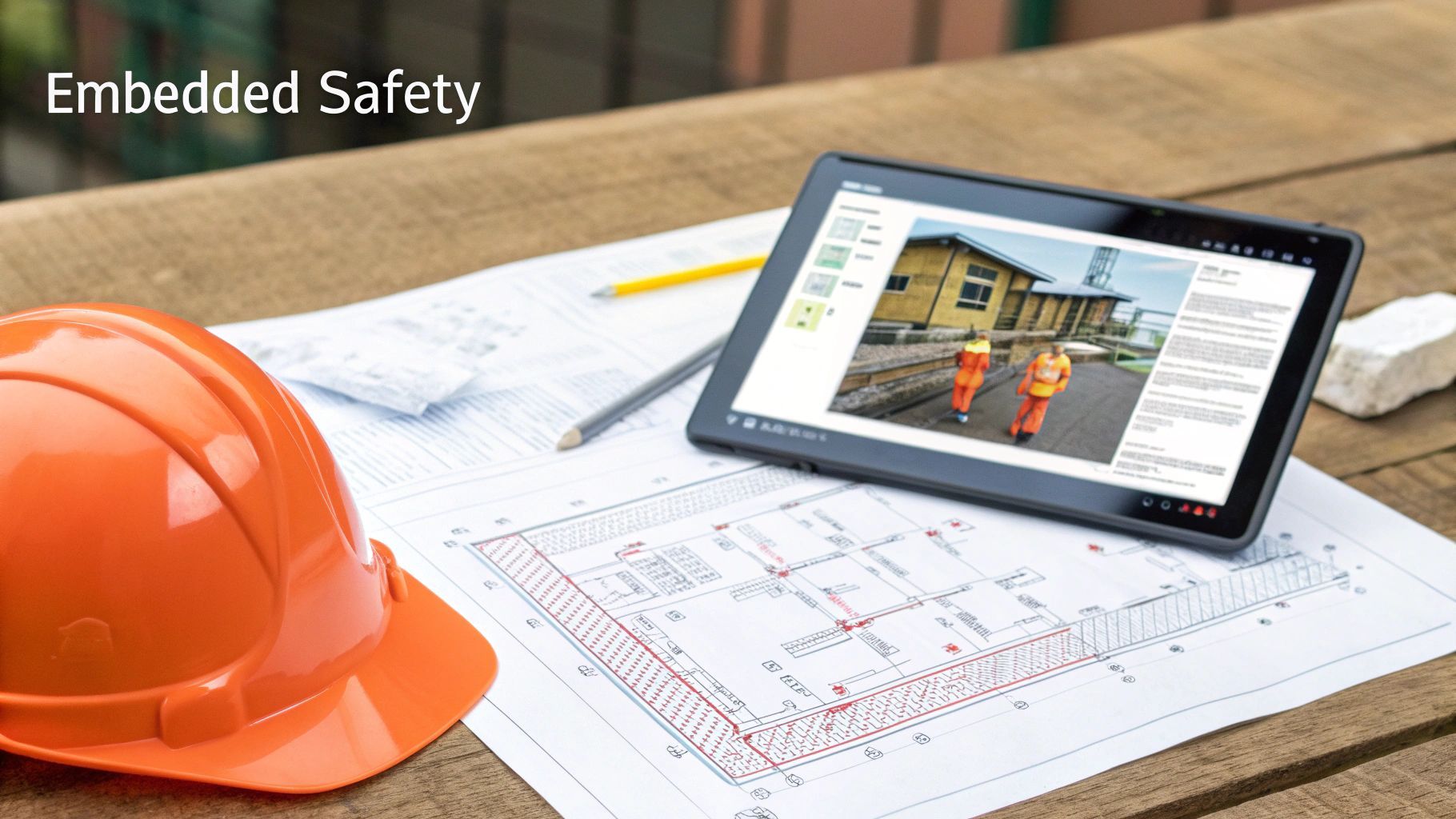
The real game-changer is the AI’s ability to automatically generate Job Hazard Analyses (JHAs) by deeply reading and understanding project documents. The system pores over plans and specs, identifies every scope of work, and cross-references them with known OSHA-defined risks. This isn’t guesswork; it’s a data-driven approach that makes sure your safety plan is comprehensive and tailored to the actual project.
For instance, if the plans show extensive work happening above six feet, the AI immediately flags it. It then generates the required JHA for fall protection, complete with recommended controls and relevant citations. Your team isn’t starting from a blank page anymore. They’re getting a structured, actionable safety plan as one of the first outputs of the bidding process.
This transforms safety planning from a manual, often-rushed chore into an automated, data-backed strategy. When you embed compliance directly into your bid, you’re not just cutting down on future risk—you’re building a serious competitive advantage.
Building Bids on a Foundation of Documented Safety
Having these JHAs and other safety documents ready from the get-go has a massive impact. You’re no longer just submitting a number; you’re delivering a bid package that rests on a solid foundation of documented compliance. It’s a clear signal of professionalism and diligence that savvy clients really notice.
This approach gives you tangible, auditable results:
- JHA Generation: The AI produces initial JHAs that are directly mapped to specific scopes found in the RFP documents.
- Risk Identification: It automatically flags high-risk activities like excavation, confined space entry, or work near live electrical systems.
- Cited Controls: Every single safety control it recommends is linked directly back to the source document, creating a crystal-clear audit trail.
Of course, handling this kind of sensitive project and safety information demands serious security. To see how top platforms safeguard your data, you can learn more about Halozen.AI, which is built to meet SOC 2 and ISO 27001 standards. By using AI to front-load safety, you aren’t just putting a bid together—you’re engineering a safer, more compliant, and more successful project right from the start.
Bringing AI into Your Precon Workflow
Let’s be honest, bringing in new tech can feel like a massive undertaking. Your team is already running at full capacity, and the thought of a complicated rollout is enough to make anyone hesitant. When we talk about AI in construction estimating, it’s natural to wonder about the learning curve, data security, and how it will actually fit into the daily grind.
But here’s the thing: the right approach flips the script. Instead of adding another layer of complexity, a well-designed AI tool should start by solving your biggest headaches—the mountain of RFPs, the endless search for risky clauses, and the soul-crushing compliance paperwork. It should deliver value right out of the gate.
Answering the Big Questions: Security and Integration
Handing over sensitive bid documents to a new platform is a big deal, and it should raise security questions. This is where you need to look under the hood of any potential AI partner. A platform built for construction must be built on a foundation of enterprise-grade security.
Don’t just take their word for it. Look for independent, third-party proof:
- SOC 2: This certification is a big one. It confirms the provider has proven, audited systems for keeping client data secure and private.
- ISO 27001: This is the international gold standard for information security, showing they have a rigorous, systematic process for protecting your data.
These aren’t just buzzwords; they’re your assurance that your project data is locked down. On the integration front, the best tools don’t require a massive IT project. You shouldn’t have to rework your entire tech stack, like Procore or Autodesk, just to get started. They should work as standalone power tools that take your documents and give you back actionable outputs—like cited risk reports, draft JHAs, or a submittal register—often in under 72 hours.
Side-Stepping Common Pitfalls
To get this right, you have to avoid a couple of common traps. The biggest one is trying to use a generic AI tool that wasn’t built for construction. A general-purpose AI might be great at summarizing an article, but it doesn’t know the difference between a liquidated damage clause and a standard warranty requirement. It will miss the nuance that can make or break a project.
The other major misstep is bolting AI onto your old, manual process and hoping for magic. You won’t see the real benefit. The goal is to reshape your workflow around this new capability. That means trusting the AI-generated submittal register to get a head start on planning. It means using the 95%+ clause coverage to make go/no-go decisions in hours, not weeks. By avoiding these traps and picking a purpose-built tool, you can make the transition smooth, fast, and incredibly valuable.
Connecting AI Adoption to Your Bottom Line
Adopting new technology isn’t just about bells and whistles; it’s about making a real, measurable impact on your company’s finances. When we talk about AI in construction estimating, the conversation has to move past the cool tech and focus squarely on the return on investment (ROI). This isn’t about small, incremental gains. It’s about a fundamental shift in how your firm handles risk, chases work, and protects its profit margins.
The most obvious financial win comes from slashing your risk exposure. Think about it: when your team is manually digging through a 300-page RFP, mistakes are bound to happen. A single missed clause on liquidated damages or an unusual insurance requirement can easily cost you tens of thousands of dollars. AI platforms practically eliminate this problem, providing over 95%+ clause coverage and ensuring every critical detail is flagged before your bid ever goes out the door.
This isn’t just about dodging bullets; it’s about setting up more profitable projects right from the start.
Turning Bidding Capacity into a Competitive Weapon
Beyond just playing defense, AI gives your team a serious offensive advantage by completely changing its capacity. Estimators using AI are saving an average of 23.5 hours on document review for every single project. That time doesn’t just disappear—it gets reinvested.
Freed from the grind of paperwork, your team can pursue more work, allowing your firm to bid on more projects without having to hire more people. This directly fuels your revenue pipeline. Your best people can stop being document reviewers and start focusing on high-value strategies like value engineering and sharpening subcontractor bids. This is how preconstruction evolves from a cost center into a growth engine.
By using AI to cut costs, protect margins, and dramatically increase bidding capacity, your firm gains a clear advantage in a tough market. You stop competing just on price and start winning with speed and thoroughness.
A Market Shift You Can’t Afford to Ignore
This move to AI isn’t just a passing fad; it’s a massive shift in how the industry operates. The global AI in construction market is absolutely exploding, projected to jump from $4.86 billion in 2025 to a staggering $22.68 billion by 2032.
The proof is already here. U.S. construction firms that are already using AI are reporting cost reductions of up to 20% and are delivering projects 30% earlier than their old-school competitors. You can find more data on AI’s growing market footprint over at OpenAsset.com.
This data paints a very clear picture: firms that drag their feet on this technology will get left behind by competitors who are faster and more efficient. For a parallel example, look at how AI contract review solutions are speeding up legal workflows—the same efficiency gains are happening right now in preconstruction. Ultimately, investing in AI isn’t just an operational upgrade; it’s a strategic move essential for your company’s long-term financial health and leadership in the market.
How Long Does It Take to Get Results?
You’re facing an RFP avalanche right now, so you don’t have time for a drawn-out implementation project. The right solution should deliver value almost immediately. For example, a tool like Halozen.AI can turn a massive stack of documents into actionable, bid-ready outputs in under 72 hours.
This isn’t just a data dump, either. You get structured deliverables that plug right into your workflow:
- A complete, indexed list of all contractual requirements.
- Draft JHAs are already mapped to the identified scopes of work.
- A preliminary submittal register with all the triggers and timelines laid out.
The global AI in construction market is projected to reach $22.6 billion by 2032. Firms adopting these tools are already seeing 20% cost reductions and 30% faster delivery.
Investing in AI isn't just an operational upgrade; it’s a strategic move to protect your margins and transform your preconstruction team from a cost center into a growth engine.
Stop drowning in RFPs and start winning with data. See how Halozen.AI turns 200-page tenders into actionable insights in under 72 hours.