

For preconstruction teams, a new RFP landing in your inbox isn’t just another document—it’s the start of a high-stakes sprint. The real challenge isn’t the sheer number of bids you’re juggling; it’s the maddening complexity buried deep inside each one.
You’re up against a triple threat: a constant flood of RFPs, the soul-crushing manual hunt for critical clauses hidden in hundreds of pages, and the immense pressure to get safety and contractual compliance perfect. Miss one small detail, like a specific insurance rider or a unique safety protocol, and your bid is dead on arrival.
The Real Price of a Manual RFP Process
The data tells a sobering story. Responding to RFPs is a numbers game now, with some enterprise teams tackling over 150 submissions a year. In financial services, for instance, teams average 164 responses annually—a workload that directly drains resources and impacts the bottom line.
But here’s the good news. Teams that switch to modern response tools are seeing a 76% reduction in time spent per response and a 59% improvement in win rates. The path to better outcomes is crystal clear.
The diagram below really drives home the difference between a clunky, manual workflow and a clean, optimized one.
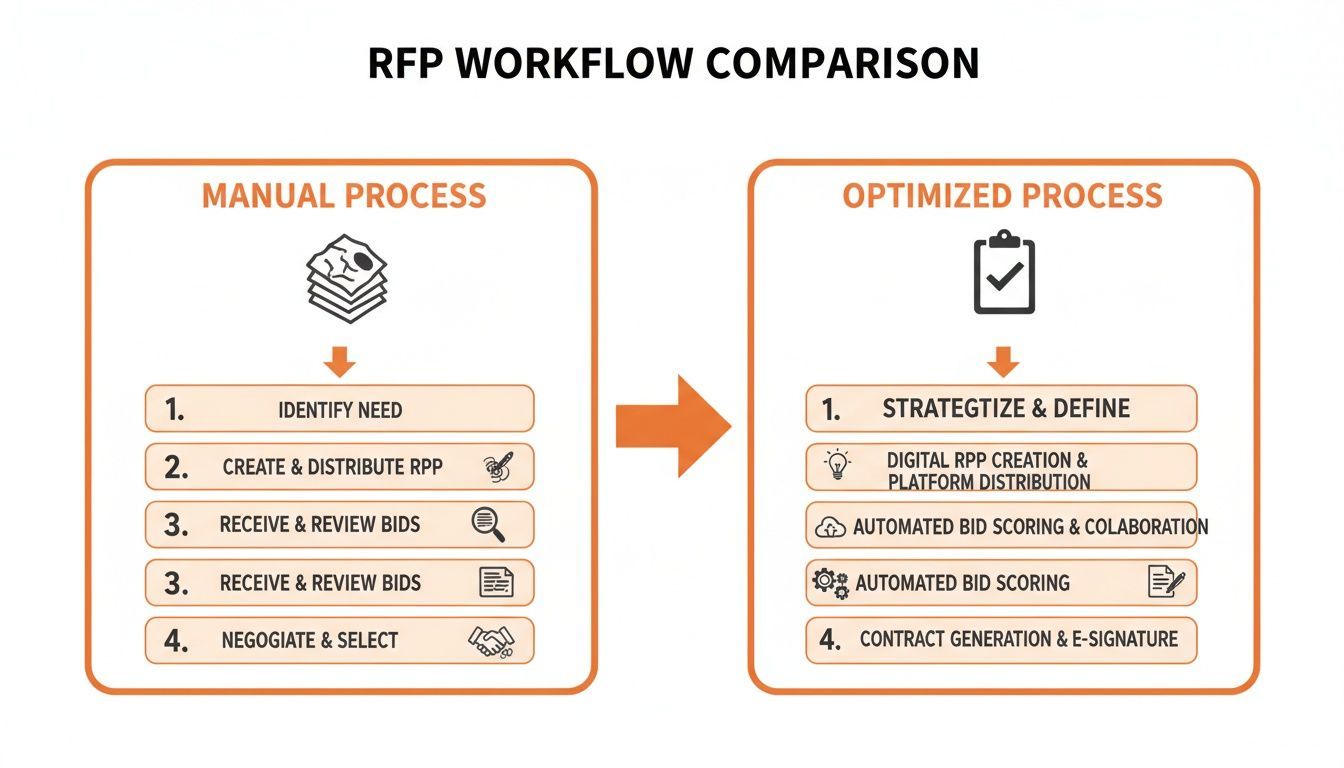
This visual shows how an optimized process transforms chaotic, manual steps into a reliable, repeatable system. It cuts down risk and, just as importantly, gives you back your time.
The Manual vs Optimized RFP Workflow
The table below breaks down the hours and risks associated with each stage of the RFP response, comparing the old way with a modern, optimized approach. It’s a stark contrast that highlights where the biggest gains are made.
RFP Stage | Manual Approach (Hours/Risk) | Halozen.AI Optimized Approach (Hours/Risk) | Key Outcome |
Initial Review & Go/No-Go | 4-6 hours (High risk of misjudgment) | <1 hour (Low risk, data-driven) | Faster, more accurate bid decisions. |
Clause & Requirement Extraction | 10-15 hours (High risk of missed items) | 1-2 hours (Minimal risk) | 95%+ clause coverage and complete requirements capture. |
Safety Analysis (JHA/JSA) | 8-12 hours (Moderate risk of error) | 2-3 hours (Low risk) | Project-specific safety plans generated in record time. |
Submittal Register Creation | 6-8 hours (High risk of incomplete list) | <1 hour (Minimal risk) | A comprehensive, accurate submittal log from day one. |
Final Review & Submission | 5-7 hours (Moderate risk of compliance gaps) | 1-2 hours (Low risk) | Confident submission with a complete audit trail. |
Moving from a manual grind to an optimized workflow isn’t just about saving a few hours here and there. It’s about fundamentally changing the game—reducing burnout, minimizing risk, and freeing up your best people to focus on strategy, not paperwork.
From Chaos to a Winning Strategy
The fix is to stop reading and reacting, and start deconstructing. Winning teams treat the RFP not as a book to be read, but as a data source to be mined.
It all comes down to focusing on specific, tangible outputs from the very beginning:
- Cited Extractions: Every single requirement, penalty, and key date gets pulled and linked directly back to its source page in the document. This creates a bulletproof audit trail and ensures you hit 95%+ clause coverage.
- Rapid Deliverables: This extracted data is then used to auto-generate the critical documents you need for preconstruction. We’re talking about project-specific Job Hazard Analyses (JHAs) and a complete submittal register, often turned around in under 72 hours.
- Quantified Savings: This systematic approach regularly saves an average of 23.5 hours of an estimator’s valuable time on every single bid.
Increasingly, enterprise clients are including detailed security questionnaires in their RFPs, making compliance with frameworks like NIST non-negotiable. A structured approach ensures you spot these complex requirements early. If you’re dealing with these, a solid NIST compliance guide is a great resource for getting up to speed on the technical standards. By turning chaos into a predictable workflow, your team can finally stop drowning in documents and start building winning proposals.
Making Smart Go/No-Go Decisions

The moment a new RFP lands, the clock starts ticking. For preconstruction teams already buried under a mountain of documents, the gut reaction is often to dive right in. I’ve seen it time and again—it’s a critical mistake. Chasing every single opportunity is a surefire way to burn out your team and tank your win rate. You end up spreading your best people too thin on bids you were never really positioned to win in the first place.
The real challenge isn’t just the sheer volume of RFPs; it’s the complexity hidden inside. Deal-breaking clauses, impossible safety requirements, and brutal deadlines are often buried deep within hundreds of pages. A manual review just to figure out if a bid is even viable can take days, eating up precious time from senior estimators who should be crafting strategy, not hunting for clauses.
This initial triage is single-handedly the most important part of your RFP response process. A disciplined go/no-go system cuts through the noise, letting you focus all your firepower on the opportunities where you actually have a high probability of success.
Building Your Go/No-Go Scoring Matrix
Your scoring matrix needs to be your own, but it should always evaluate opportunities across a few key dimensions. Think of these as the absolute essentials:
- Strategic Alignment: Does this project actually fit our long-term business goals? Is it with a key client we want to grow with, or in a market we’re targeting?
- Capability Fit: Do we have the proven experience, the right equipment, and the skilled people to knock this out of the park? Are there any oddball requirements we can’t handle?
- Risk Profile: What are we looking at for contractual, safety, and financial risks? Are there unusual liability clauses or harsh penalty terms that expose us to too much?
- Resource Availability: Is our A-team actually free? Promising a client your best and then not having them available is a recipe for disaster.
- Profitability Potential: After all is said and done, does the project offer a healthy enough margin to justify the effort and risk?
By assigning a weight to each category, you can generate a hard number for every RFP. That score gives you a clear, objective starting point for the conversation. For instance, a bid might score high on profitability but tank on strategic fit and risk, immediately flagging it for a much closer look or a quick “no-go.”
This systematic evaluation is the bedrock of a winning bid strategy. When you can spot deal-breakers like crushing safety compliance demands or hidden penalty clauses in the first few hours, you save your team an average of 23.5 hours per bid. That reclaimed time is a massive competitive advantage.
To see how this efficiency can impact your bottom line, you can explore different pricing models for services that deliver these kinds of outcomes. It’s all about focusing your resources on crafting winning proposals for the right projects.
You’ve given the RFP the green light. Now, the real work starts. This next phase is where most bids are won or lost—not in the final price, but in the trenches, dissecting the document for every single requirement.
This is the tedious, high-stakes hunt for clauses that preconstruction teams know all too well. It’s a manual grind that’s practically begging for a costly mistake.
The reality is, a single missed clause can be a project killer. Whether it’s an obscure safety mandate or a subtle penalty for a schedule slip, one oversight can get you disqualified or lock you into a loss-making job. We see it all the time. Estimators spend an average of 23.5 hours per bid just trying to hunt down and track these details. That’s a huge drain on resources that should be spent on strategy.
Turning Raw Data into a Winning Strategy
A long list of extracted clauses is just noise. The magic happens when you start sorting them into actionable categories. This is how you turn a mountain of text into a clear roadmap for your proposal.
A good starting point for categorization looks something like this:
- Safety & Environmental: Are they calling for specific OSHA/WHS standards? What about certifications or emergency response plans?
- Commercial & Legal: This is where you find the tricky stuff—payment terms, liability caps, insurance minimums, and penalty clauses.
- Technical Specifications: Here, you’ll find material standards, performance requirements, and quality control protocols.
- Project Management: Look for reporting frequency, key milestone dates, and all-important submittal deadlines.
This isn’t just theory. The industry is waking up to the need for better tools to manage this flood of information.
The data here, from a Responsive.io report, is telling. While only 13% of teams have fully adopted specialized AI for RFP responses, the vast majority are seeing a return on that investment within the first year. Moving away from manual clause hunting delivers real financial and operational results.
The Master Compliance Matrix: Your Single Source of Truth
All this meticulous work culminates in one place: the master compliance matrix. This isn’t just another spreadsheet. It’s the central nervous system for your entire bid—a living document that tracks every requirement, who’s responsible for it, its status, and a direct link back to the source.
This matrix is where your team comes together.
- The safety team uses it to build project-specific Job Hazard Analyses (JHAs).
- The project management team uses it to create the submittal register.
- The bid manager uses it as a final check to ensure every part of the proposal is 100% compliant.
By getting this done upfront, you kill the last-minute scramble and dramatically slash your compliance risk. More importantly, you build a powerful, evidence-based proposal that proves you understand the client’s needs better than the competition.
Common Questions About Responding to RFPs

If you’re on a preconstruction or tender team, you know the drill. The RFP hits your desk, and the pressure is on. You’re juggling a massive workload and know that missing a single clause could cost you the entire bid. Let’s tackle some of the most common questions we hear from teams in the thick of it.
What’s the First Thing to Do When an RFP Lands?
Stop. Before you do anything else, you need a disciplined go/no-go process. The single biggest mistake I see teams make is jumping straight into reading clauses without asking the most important question: “Should we even bid on this?”
This is exactly how you end up sinking an average of 23.5 hours into a proposal you were never going to win.
A simple scoring matrix is your best friend here. Evaluate the RFP against your core capabilities, current team availability, and strategic goals. This kind of structured triage helps you kill off bad-fit projects in a few hours, not days, so your team can pour their energy into the bids you can actually win.
How Can We Make Our Bids More Accurate?
Bid accuracy isn’t guesswork; it’s a direct result of meticulous, auditable clause extraction. Your goal should be to get beyond just reading the document and start systematically mining it for every single requirement. You should be shooting for over 95%+ clause coverage to close off those dangerous compliance gaps for good.
The key is to build a master compliance matrix. In it, every requirement—from specific safety protocols to obscure commercial terms—is linked directly back to its source page in the RFP. We call this cited extraction, and it gives you a bulletproof foundation for your proposal. It also ensures that critical documents, like your Job Hazard Analyses (JHAs), are built on solid, client-specific data.
Why Do So Many Preconstruction Bids Fail?
From what I’ve seen, bids usually fail for one of three reasons: you weren’t compliant, you missed a deadline, or you submitted a generic proposal that didn’t speak to the project’s real risks. Today’s RFPs are minefields. A single safety requirement buried on page 200 can get you disqualified instantly. This happens all the time when teams are stuck with manual “clause hunting.”
Another huge mistake is sending boilerplate responses instead of tailored, high-value deliverables. When you submit a bid that already includes a project-specific submittal register or a draft JHA, you’re proving you’ve done your homework. You understand their unique needs and are ready to get to work. Generic answers just scream that you’re unprepared.
“The shift toward strategic response management is undeniable. While many firms are experimenting with better tools, those who fully commit are seeing massive returns. It’s no longer about just answering the RFP; it’s about demonstrating superior preparedness from the very first interaction.”
The data backs this up. A recent sector report noted that while many firms are just dipping their toes in new tech, of the 13% of firms that had fully deployed AI for their RFP responses, most saw a positive ROI within the first year. You can dig into these findings on strategic response management at Responsive.io.
If your team is drowning in RFP demands and you want to trade the manual chaos for a structured, winning process, we can help. Feel free to get in touch with our team of experts to talk about how you can put these strategies to work.
Ready to stop the manual grind and start winning more bids? Halozen.AI turns your most complex RFPs into bid-ready deliverables like cited extractions, JHAs, and submittal registers in under 72 hours. See how it works at Halozen.AI .