
What is construction bid management software, and how can you use it to win more work?
Think of it as the central command center for your entire bidding process. For too long, contractors have been stuck juggling spreadsheets, digging through endless email chains, and trying to keep track of paper logs. Your first step is to recognize this chaos. This software takes all that scattered, manual work and consolidates it into a single, automated platform. Implement it to manage everything from bid invitations to subcontractor communications and those all-important deadlines.
In a hyper-competitive market, this isn't just a nice-to-have; it's the technology you must leverage to gain a decisive edge in both speed and accuracy.
Why Bidding Software Is Your Digital Control Tower

Picture trying to land a dozen planes at a busy airport with nothing but a walkie-talkie and a notepad. It sounds insane, right? Yet, that's what traditional construction bidding looks like—it’s chaotic, wide open to human error, and incredibly risky.
Key details vanish into massive email threads, deadlines get missed because someone forgot to update a spreadsheet, and trying to compare subcontractor bids is a nightmare of apples-to-oranges formatting.
This is precisely where you must deploy construction bid management software. Use it as your digital air traffic control to transform the entire bidding process from a high-stress guessing game into a methodical, data-driven operation.
From Manual Chaos to Automated Clarity
The most immediate action is to establish order. Use the software to create a single source of truth where every piece of bid-related information lives, breathes, and gets updated for everyone to see in real-time. Moving from fragmented workflows to one central hub is the single biggest action you can take to improve your bidding.
Instead of your estimators burning valuable hours on manual data entry or chasing down subs for a simple piece of information, direct the software to handle those repetitive tasks automatically. This builds a structured environment where you can track every action and access every document with a click.
Actionable Insight: Build a data-driven bidding strategy. Use the software as a central hub for real-time insights from your business. This will boost both your accuracy and your team's productivity.
The difference between the old way and the new way is stark. Let’s break down the specific actions you can take with this software to solve your most frustrating challenges.
Traditional Bidding vs Software-Powered Bidding
Manual Bidding Challenge | Your Actionable Software Solution |
Hours spent manually sending out individual ITBs and tracking who has opened them. | Execute one-click bid invitations to your entire subcontractor network. Actively monitor the real-time tracking of opens and responses. |
Project documents (plans, specs, addenda) are scattered across emails, leading to outdated bids. | Establish a central document repository. Direct your team and subs to this single source for the latest files to eliminate costly rework. |
Communication is lost in disorganized email chains, creating risk and potential disputes. | Mandate in-platform messaging for all project communication. Use this to create a clear and auditable record. |
Comparing subcontractor bids is a nightmare of inconsistent formats and missing information. | Implement standardized bid forms and use side-by-side comparison tools to make leveling bids quick, easy, and accurate. |
Tracking deadlines relies on manual calendars and memory, leading to missed opportunities. | Set up automated deadline reminders and use the visual project timeline to keep your entire team on track without constant follow-up. |
As you can see, the software doesn't just digitize the old process—it fundamentally redesigns it. Take these actions to turn common pain points into competitive strengths.
Key Operational Improvements
Adopting this technology brings immediate, tangible improvements. Here are the actions to take to benefit both general contractors and their subs.
- Centralize Bid Invitations: Use the single dashboard to broadcast invitations to bid (ITBs) to your entire network. Stop managing dozens of separate email threads just to get the word out.
- Organize Document Management: Store all project files, drawings, and specs in one place. Instruct subcontractors to log in and grab the latest information instantly, which drastically reduces the risk of them bidding on outdated plans.
- Maintain Clear Communication Trails: Use the in-platform messaging to tie every conversation to a specific project. This creates a clear, auditable communication history that will protect your firm from "he said, she said" disputes down the line.
At the end of the day, construction bid management software isn't just another tool to add to the pile. It represents a fundamental shift. Implement it to free up your team to focus their expertise on strategy and building relationships, not getting buried in administrative busywork.
What Makes a Winning Bid? It's All in the Details.
Effective construction bid management software is more than a digital filing cabinet. Its value comes from core features that give your team a serious edge. Use these features to move faster, bid smarter, and protect yourself from unnecessary risk.
The industry is adopting this tech fast. The global market is projected to jump from USD 1.16 billion in 2025 to USD 2.12 billion by 2029. This isn't just a trend; it's a fundamental shift. Here are the features you need to leverage.
AI-Powered RFP Parsing and Analysis
Think about the last time your team stared down a 500-page RFP. An estimator can burn days just hunting for critical requirements. This manual grind is slow and a breeding ground for costly mistakes.
This is where you must leverage AI-powered parsing. Good software acts like a superhuman assistant, scanning monster documents in minutes. It instantly pulls out vital information and organizes it, turning a wall of text into a clear, actionable game plan.
- Track Key Dates and Deadlines: Use the AI to snag every submission deadline, pre-bid meeting, and RFI due date. Ensure nothing falls through the cracks.
- Verify Compliance Requirements: Let the software flag all the must-haves—certifications, insurance minimums, bonding capacity, and safety protocols—so you are compliant right from the start.
- Identify Penalties and Risks: Use the system to spotlight risky terms like liquidated damages clauses or project penalties. Bring these items to your go/no-go meeting for a serious review.
This isn’t just about saving hours. It’s about freeing up your best people. By automating the grunt work, you empower your team to focus on winning. For example, many platforms now integrate tools for AI-powered RFP response creation that you can use to further accelerate the process.
Automated Submittal and Compliance Registers
You’ve found all the requirements. Now you have to track them. The old way? Building a colossal spreadsheet—a recipe for stress and typos.
Actionable Insight: Transform compliance from a manual chore into an automated workflow. Use your software to create an instant checklist that ensures nothing gets missed before you hit "submit."
Modern software does this for you automatically. As the AI reads the RFP, it’s already building a comprehensive submittal register.
Every required item is logged and linked back to its source. Assign due dates and responsible team members directly in the platform. This gives your pre-construction team an instant roadmap of everything that needs to get done. The result is a massive reduction in prep time and a huge boost in the quality and completeness of your bid.
The Indisputable Power of an Audit Trail
We’ve all been there. A simple miscommunication spirals into a full-blown dispute. This is why a rock-solid audit trail is one of the most valuable features you must use.
An audit trail is your firm's black box—an indisputable, time-stamped record of every single action and conversation related to a bid.
What to Track with Your Audit Trail
Action Type | What to Record | How to Use It |
Document Views | Exactly who opened which file and when. | Prove a subcontractor saw the latest addendum. End the excuses. |
Bid Invitations | Time-stamped proof of when ITBs were sent. | Settle any debate over whether a sub was invited to bid. |
Communications | A central log of all messages, RFIs, and answers. | Create one single source of truth for every project discussion. |
Bid Submissions | A clear record of when subs sent their bids. | Provide undeniable evidence of submission times and revisions. |
This complete history is your ultimate protection. When a subcontractor claims they never got the memo, pull up a report in seconds showing they not only received it but opened it. Use this level of transparency not just to minimize risk, but to build a foundation of trust.
Calculating the ROI of Your Bidding Software
Sooner or later, every conversation about new technology hits the same question: What’s the ROI? It's not enough to talk about "efficiency." Stakeholders want numbers. You have to move past abstract promises and build a real-world case for investing in construction bid management software.
The good news is, the value is both massive and measurable. The global market for this software hit USD 783 million in 2023 and is on track to pass USD 2 billion by 2030. That growth is happening because firms are proving that automating bids and cutting errors delivers a serious competitive advantage.
Quantifying Your Time Savings
The first return you'll see is time. Your estimators are some of your most valuable people, yet they often spend their week buried in administrative busywork.
This is where the software pays for itself. To calculate this, first track the hours your team spends on manual RFP analysis, document distribution, and communication logs. Then, use the software to automate these tasks and measure the time saved. You can put a real dollar value on all those reclaimed hours, freeing up your best people to focus on high-level strategy that wins bids.
The flow is simple: save time, improve accuracy, and lower your risk. Those three things lead directly to more wins.
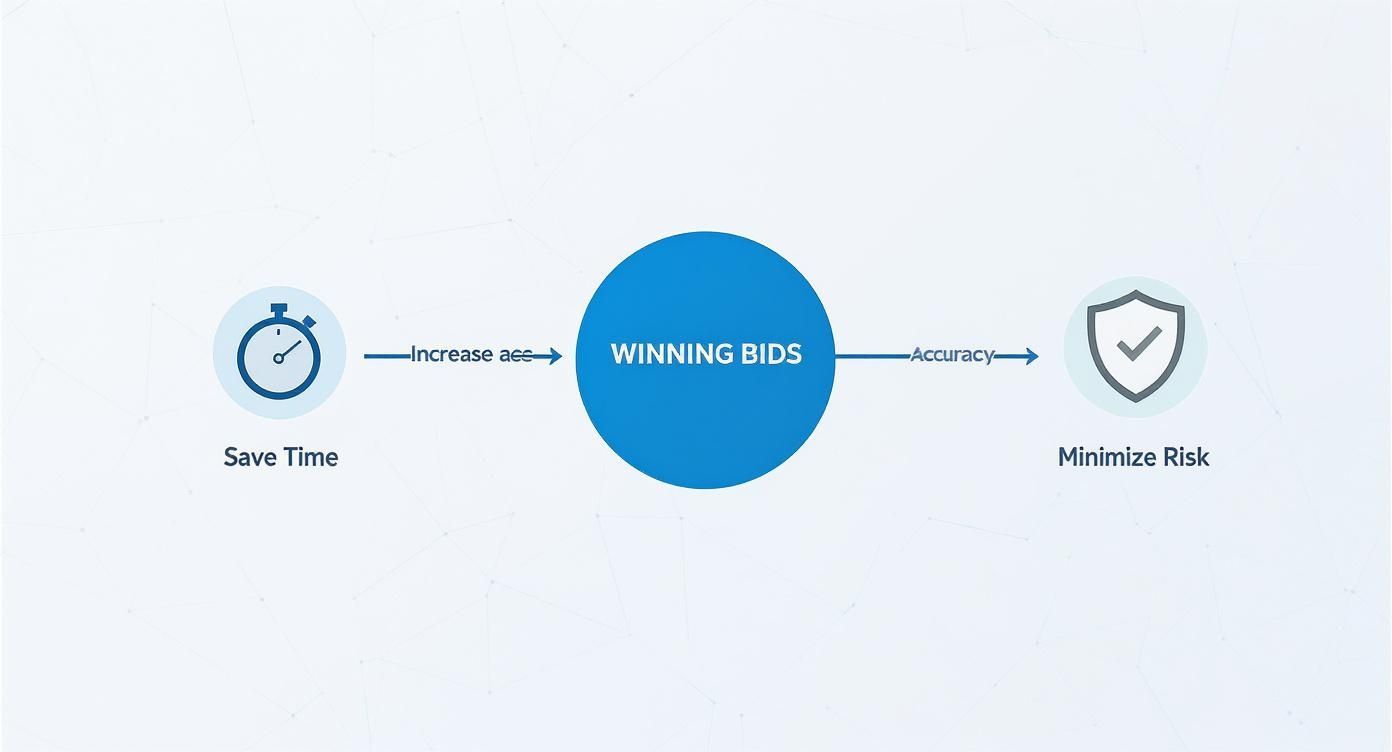
This drives home the point that winning isn't just about being the low bidder. It’s the outcome of a well-oiled process—exactly what this software helps you build.
The Financial Impact of Increased Bid Capacity
Saving time is one thing, but what you do with that time is where the real magic happens. Use automation to give your team the ability to bid on more work without burning out. When your team can turn proposals around faster, you can chase more opportunities. In fact, you can aim to increase your bid volume by 30% or more.
This is where the ROI argument becomes a no-brainer. Even a small bump in your win rate, spread across more bids, can have a massive impact on your revenue. If you want to get into the details, you should calculate ROI to prove investment value for any new technology.
Actionable Insight: Don't just do the same work faster. Use the extra bandwidth to pursue and win more projects, fundamentally changing the growth curve of your entire company.
To put this into perspective, let's walk through a quick, hypothetical scenario for a mid-sized general contractor. Use this table as a model for your own calculations.
Hypothetical ROI Calculation for a Mid-Sized Firm
This table demonstrates the potential financial return on investment from adopting bid management software, based on increased efficiency and win rates.
Metric | Before Software | After Software | Annual Financial Impact |
Bids Submitted Annually | 50 | 65 (+30%) | - |
Average Bid Win Rate | 10% (5 wins) | 12.3% (8 wins) | 3 additional projects won |
Average Project Profit | $150,000 | $150,000 | $450,000 |
Annual Software Cost | $0 | -$25,000 | -$25,000 |
Net Annual ROI | - | - | $425,000 |
As you can see, the numbers speak for themselves. Winning just three extra projects a year can generate a return that’s more than 10 times the software's cost. The math is clear: the cost of sticking with the old way is often far greater than the cost of the software.
Understanding this return helps when comparing options. For example, looking at https://www.nextbid.ai/pricing shows how a predictable, fixed-fee model makes it easier to map out your ROI. It turns the decision from a leap of faith into a sound financial strategy.
Precision AI for Flawless Requirement Extraction
At its core, NextBid.ai transforms dense specifications into a clear, actionable roadmap. Think of it as an expert assistant that never misses a detail. This system is purpose-built to hunt down and pull out the elements that can make or break your bid.
This AI-powered analysis is engineered for extreme precision, achieving over 95% clause and page coverage. Use it to find and sort what your team needs to know:
- Cited Requirements: The system flags every obligation, from material standards to project milestones, so you can build a fully compliant bid.
- Hidden Penalties: It puts a spotlight on high-risk clauses like liquidated damages, giving your team the heads-up they need to bid with confidence.
- Key Dates and Triggers: Critical deadlines, RFI due dates, and other trigger events are automatically extracted and organized, forming the skeleton of your bid timeline.
By automating this step, NextBid.ai frees your team from low-value work. Let them focus on what they do best: strategic pricing and building stronger subcontractor relationships. That shift leads directly to a more competitive proposal.
From Raw Data to Bid-Ready Deliverables
Information without structure is just noise. NextBid.ai turns raw data into organized, audit-proof deliverables that are ready for your team to use. Within 72 hours, the platform gives you a complete package designed to accelerate your go/no-go decisions and get you price-ready.
Actionable Insight: Compress your entire document review process from a week-long marathon into a three-day sprint. This speed doesn't sacrifice accuracy; it enhances it by providing a traceable, verifiable foundation for your entire bid.
The platform’s outputs are formatted for immediate use as export-ready DOCX and CSV files. This makes plugging the insights into your existing workflows seamless. Your team receives a comprehensive submittal register, complete with trigger events and due-relative dates, so no one has to build one from scratch.
Even better, NextBid.ai generates two toolbox-ready Job Hazard Analyses (JHAs) that map tasks, hazards, and controls directly to OSHA and WHS standards with locked citations. This is a massive head start for safety managers and ensures your bid meets stringent safety compliance from day one. To see how this transforms bidding, get a full overview of the solution at NextBid.ai.
This focus on actionable outputs ensures every piece of information is immediately useful, helping your estimators, project managers, and safety officers work from a single source of truth. The result? Fewer rework loops, shorter review meetings, and a faster path to submission.
A Practical Checklist for Choosing the Right Software
Picking the right construction bid management software is a huge decision. With so many options, it’s easy to get overwhelmed. The key is to find a platform that fits your workflow, not one that forces you into a rigid process. You're looking for a partner, not just a product.

The market for these tools is projected to jump from USD 0.96 billion in 2024 to USD 2.67 billion by 2033. This reflects a real industry need for smart, secure, and scalable bidding platforms. Here’s what to look for.
Core Functionality and Integration
First, ensure the software can do the job. Look past flashy sales pitches and focus on the bedrock features your estimators will rely on every day. Your goal is a tool that makes their current process better.
Just as important is integration. A platform that can’t connect to your other systems is just another data silo. The real magic happens when your bid management software talks seamlessly to your other tools.
- RFP and Document Handling: Can it process a complex, 300-page RFP without choking? Does it handle all the different file types you use?
- Subcontractor Communication: Is there a central hub for sending ITBs, tracking responses, and keeping all communication in one place?
- Integration Capabilities: Does it have APIs or pre-built connections for your ERP, accounting software, or project management platforms like Procore or Autodesk Construction Cloud?
Evaluating Usability and Support
Even the most feature-packed software is a waste of money if your team hates using it. A clunky interface is the fastest way to kill adoption. Always prioritize a clean, intuitive design that requires minimal training.
Don't forget to test customer support. When you're against a tight deadline and something goes wrong, you need a responsive team that knows what they’re talking about. A vendor who acts like a true partner is invaluable. In fact, learning about the mission and team behind the software can give you a gut check on how much they care about their customers' success.
Actionable Insight: Insist on a platform that combines powerful features with an intuitive user experience. If your team can't use it easily, the promised efficiency gains will never materialize.
Red Flags to Watch Out For
As you evaluate options, keep an eye out for warning signs. Asking tough questions now can save you a world of hurt later.
- Hidden Fees: Look beyond the sticker price. Ask if they charge for implementation, training, data migration, or extra user seats. Push for a clear, all-in pricing model.
- Vague Security Protocols: Don't accept fuzzy answers on security. Demand clear documentation on their data protection measures, like SOC 2 or ISO 27001 compliance.
- Lack of Scalability: Ask how the software will grow with you. A tool that feels right today might become a bottleneck when you start chasing bigger projects tomorrow.
Frequently Asked Questions
Jumping into any new software is bound to bring up questions. You need to know how it will impact your workflow, your budget, and your team. Let's tackle some of the most common ones.
How Long Does This Actually Take to Set Up?
We've all heard the horror stories of software rollouts that drag on for months. Thankfully, with modern cloud-based tools, you're looking at days or weeks, not months.
The actual timeline comes down to a couple of key things:
- Your Data: Do you have years of old bid documents or massive subcontractor lists to import? A good platform makes this straightforward, but it takes time to organize.
- Your Team: How many people need to get up to speed? The best tools are intuitive, so training is usually quick.
Is This Really Affordable for a Smaller GC?
Absolutely. The idea that this software is only for giant firms is a myth. The Software-as-a-Service (SaaS) model changed the game.
Instead of a massive upfront investment, you pay a predictable monthly or annual fee. This levels the playing field, giving smaller GCs access to the same competitive advantages. Most platforms offer different pricing tiers, so you only pay for what you actually need.
How Well Does This Play with Our Other Software?
This is the million-dollar question. The last thing you want is another piece of software that doesn't talk to anything else. The best bid management platforms are built to integrate with the tools you already use.
Using APIs (digital handshakes between programs), your bidding software can connect directly with project management platforms like Procore or Autodesk Construction Cloud, as well as your accounting system. This connection kills manual double-entry, slashes errors, and ensures that critical data flows seamlessly from pre-construction into project execution.
Ready to stop wrestling with chaotic, manual bid reviews and start running a data-driven pre-construction process? Halozen gives you the AI-powered tools to dissect complex RFPs with incredible precision. It arms your team with the audit-proof evidence and clear insights you need to win more profitable work. Discover how Halozen can give you that competitive edge today.