
In the high-stakes world of construction bidding, RFP response software is a specialized tool that takes the agonizingly slow and error-prone job of analyzing bid documents and puts it on autopilot. It uses artificial intelligence to dig through dense RFPs, specifications, and drawings, pulling out all the critical requirements. What used to take weeks of manual labor now gets done in a matter of hours, turning thousands of pages into organized, actionable data.
Why Manual RFP Analysis Is Holding You Back
Every construction bid is a race against the clock, and there’s absolutely no room for error. Despite this, a surprising number of firms are still stuck in the past, relying on a manual process for RFP analysis—a method that’s quickly becoming a major competitive disadvantage. This means estimators and bid managers are spending days, sometimes weeks, hunched over massive bid packages with nothing but highlighters and spreadsheets.

Imagine trying to build a skyscraper with hand tools. Sure, you might get it done eventually, but it would be incredibly slow, exhausting, and dangerously prone to mistakes. The same is true here. A single clause you missed, buried deep on page 742, could lead to costly rework, project delays, or serious financial penalties later on. This manual grind doesn't just eat up time; it pulls your best people away from what they should be doing: strategic pricing and risk analysis.
The True Cost of Manual Review
The hidden costs of doing things the old way go far beyond just payroll hours. This traditional method creates massive bottlenecks that threaten your ability to submit competitive, accurate, and on-time bids.
The average time to manually complete a single RFP response is 25 hours. This intense pressure often forces teams to rush, which only increases the risk of missing a key requirement or getting the pricing wrong—mistakes that can destroy your profit margins before a single shovel hits the ground.
At its core, the manual process is a breeding ground for human error. It’s built on the unrealistic expectation that someone can perfectly catch, transcribe, and cross-reference every single contractual obligation, safety rule, and technical spec without ever missing a beat. To protect your bids, you must understand the consequences of these inevitable mistakes:
- Costly Rework Loops: Finding a missed requirement after you've already submitted the bid throws your team into a frantic scramble, causing chaos and shaking the client's confidence.
- Inaccurate Pricing: If you don’t capture the full scope of work, your estimate is built on a shaky foundation. You either underbid and kill your profits or overbid and lose the project entirely.
- Increased Contractual Risk: An overlooked clause can expose your firm to unexpected liabilities, legal disputes, and claims long after the ink on the contract is dry.
- Slower Go/No-Go Decisions: Without a quick, clear picture of what the project actually demands, leadership can't make fast, informed decisions on which jobs are worth chasing.
Let's look at a side-by-side comparison of the two workflows.
Manual vs Automated RFP Response Workflows
This table breaks down how a time-consuming manual process stacks up against the efficient workflow you get with specialized RFP response software. Use this to benchmark your current process and identify where you can gain the most time.
Process Step | Manual Method (Weeks) | With RFP Response Software (Hours) |
Document Ingestion | N/A (Manual reading) | < 1 Hour |
Clause Extraction & Categorization | 1-2 Weeks | 2-4 Hours |
Submittal Register Creation | 3-5 Days | 1-2 Hours |
Compliance Matrix Generation | 2-4 Days | < 1 Hour |
First-Pass Review & Pricing Prep | 1 Week | 4-8 Hours |
Total Turnaround | ~3-4 Weeks | ~1-2 Days |
The numbers speak for themselves. The manual approach is a relic that costs time, introduces unnecessary risk, and holds back your most talented people.
This is exactly where specialized RFP response software comes in and changes the entire game. It’s not just some fancy document reader; it's a strategic tool designed to systematically take these risks off the table. By automating the extraction of every last requirement, it frees up your team to stop doing tedious busywork and start focusing on the high-value strategic thinking that actually wins bids.
What to Look For in Construction Bid Management Software
Generic RFP software just doesn't cut it for construction and infrastructure projects. To win consistently, you need a tool built for this industry—one that goes beyond keyword searches to deliver actionable operational intelligence. Here are the specific capabilities to look for.
At the heart of a strong system is AI-powered clause extraction. Picture it as your most experienced estimator, reading the entire bid package—RFPs, specs, drawings, the whole lot—and instantly pulling out every single requirement. It flags contractual obligations, spots submittal deadlines, and highlights specific safety rules that a human review can easily miss. This isn't just a time-saver; it’s a practical way to manage risk from day one.
The industry is clearly waking up to this. The market for RFP response software hit USD 1.7 billion in 2023 and is on track to reach USD 4.2 billion by 2032. This explosive growth signals a clear shift: teams are moving away from manual processes and toward tools that give them a real competitive edge. You can explore the full market analysis to see where the industry is heading.
From Raw Data to Ready-to-Use Documents
Once the AI has pulled out every clause, the software takes that mountain of raw data and automatically turns it into the critical documents that form the skeleton of your project plan. This saves hundreds of hours and ensures nothing gets lost between bid and execution.
Here’s a perfect example of how the right AI can instantly translate a dense block of RFP text into an organized, actionable list of requirements.

As you can see, the system transforms chaotic bid documents into a clean, categorized, and verifiable list of obligations. This is the foundation for both accurate pricing and flawless execution.
The key outputs you should expect are:
- Submittal Registers: Instead of manually building a list of required reports, samples, and drawings, the software generates it for you. It pinpoints every submittal, its trigger, and its due date tied to project milestones.
- Quality Control Checklists: The platform rips every single quality assurance and quality control (QA/QC) requirement from the specs and builds them into comprehensive checklists. Your team knows exactly what standards they have to hit from day one.
- Compliance Matrices: The software creates a detailed matrix that maps your proposed solutions directly back to the client's requirements. Use this to prove you've covered every base and strengthen your proposal.
A Laser Focus on Safety Compliance
In our industry, safety isn't just a talking point—it's a non-negotiable part of winning and keeping the job. The best RFP response software understands this and helps automate the tedious, early stages of safety planning.
A true standout feature is the ability to generate a preliminary Job Hazard Analysis (JHA) or Job Safety Analysis (JSA). The AI scans the RFP for specified tasks, materials, and working conditions. Then, it cross-references them against known hazards and required controls based on standards from regulators like OSHA or Safe Work Australia.
This turns safety from something you scramble to address after winning the bid into a proactive, pre-bid strategy. Your safety manager gets a data-driven draft, freeing them up to focus on site-specific details instead of starting with a blank page.
This proactive approach not only shows a deep commitment to safety in your proposal but also helps ensure your pricing accurately reflects the real cost of keeping everyone safe. It’s a powerful way to de-risk the project for both you and the client.
The Unbreakable Chain of Evidence
If there’s one feature that truly separates the best from the rest, it’s auditable citations. This means every single piece of data the software extracts—every submittal requirement, every safety rule, every contractual term—is hyperlinked directly back to its exact source in the original bid documents.
This creates an unbreakable chain of evidence. To apply this in practice, you should:
- Resolve Disputes: Settle disagreements with clients or subs in seconds by pointing to the exact source clause.
- Conduct Internal Audits: Give your team a way to double-check that the full scope of work has been captured before you submit the final price.
- Perform Risk Reviews: Provide executives with the confidence that the bid is built on a solid, verifiable foundation of facts.
This level of traceability is the ultimate defense against the costly "he said, she said" arguments that can derail a project. It ensures every decision is backed by auditable proof, protecting your margins and your reputation.
The Business Case for Automated Bid Analysis
It’s one thing to talk about advanced software features, but what really matters is how they help you win more work and protect your profit margins. The link between AI-powered RFP response software and your bottom line is surprisingly direct. It all boils down to shifting your team's focus from mind-numbing administrative tasks to the high-level strategic work that actually wins bids.
The first and most obvious win is a massive speed-up in getting ready to price the job. When the software automatically pulls out every single contractual requirement, your estimators get a complete, organized scope of work in a fraction of the time. This gives them a head start.
Instead of burning weeks slogging through thousands of pages just to figure out what the client is asking for, they can jump right into what they do best: strategic pricing, risk analysis, and finding smart value engineering opportunities. Your team doesn't just get more efficient; they become far more effective at their actual jobs.
Eliminating Costly Rework Loops
One of the surest ways to kill profitability is to miss a requirement and only discover it late in the game. That single oversight sends your team scrambling, forcing you into chaotic and expensive rework loops that burn time and erode the client’s confidence before you even put a shovel in the ground.
Let's walk through a real-world example. An estimating team is buried in a 1,500-page RFP for a new light rail project. Deep inside a technical spec addendum, a single sentence calls for a specialized, long-lead-time concrete mix. The team misses it. They submit their bid, they win, and everyone celebrates.
Two weeks later, the project manager finds the requirement, and panic sets in. The team now has to:
- Re-price the entire concrete scope under incredible pressure.
- Scramble to find a supplier who can even source the mix on a tight schedule.
- Face potential schedule delays that could trigger costly liquidated damages.
This one tiny mistake can easily flip a profitable project into a major loss. With RFP software like NextBid.ai, the AI would have flagged that specific material requirement from the very beginning, making sure it was baked into the initial estimate and procurement plan.
Creating an Auditable Evidence Trail
Another huge benefit is the creation of an auditable evidence trail for every proposal you submit. In an industry where claims and disputes are a part of life, having a rock-solid, verifiable link between your bid and the original RFP is your best line of defense.
This means every requirement, submittal, and safety protocol the system extracts is tied directly back to its source clause. There’s no more room for confusion or "he said, she said" arguments during contract negotiations or once the project is underway.
This traceability isn't just about winning arguments; it’s about preventing them from ever starting. When both you and the client can see a clear, verifiable line from the original RFP to your submitted price, it builds trust and reduces the friction that often leads to disputes.
This clear, traceable record is a powerful risk mitigation tool. It provides concrete proof that your bid is a true reflection of the client’s stated needs, protecting your firm from claims of non-compliance and shielding your profit from unexpected costs down the road.
Driving Higher Win Rates and Profitability
When you add it all up, these advantages lead directly to what every firm wants: higher win rates and more profitable jobs. The data backs this up. Research shows that teams using RFP software have win rates that are 2% higher than those who don't.
That 2% edge doesn't come from a single silver bullet, but from a combination of powerful factors:
- Speed: You can pursue more opportunities without ever sacrificing the quality of your bid.
- Accuracy: Your bids are built on a complete understanding of the scope, drastically reducing the risk of leaving money on the table.
- Confidence: Leadership can make quicker, smarter go/no-go decisions when they have a crystal-clear picture of a project's risks and requirements.
By turning a document review process that used to take weeks into something that takes a few hours, your team gains a serious competitive advantage. You can submit more bids that are more thoughtful, more accurate, and more compelling. It’s not about working faster—it’s about bidding smarter.
How to Choose the Right RFP Response Software
Making a big technology investment is always a tough call, and when it comes to RFP response software, they are definitely not all created equal—especially for the high-stakes world of construction. Use this practical framework to evaluate your options and ensure you choose a platform that truly understands what's on the line with every bid.
AI Coverage: Don't Settle for "Good Enough"
The first and most important thing to look at is AI coverage. A generic tool might catch keywords, but a platform built for construction needs to identify every contractual obligation, safety requirement, and technical spec, even if it's buried in a drawing note or hidden in a last-minute addendum.
Anything less than 95% coverage across all documents and pages is a non-starter. It introduces an unacceptable level of risk.
Challenge potential vendors on this. Ask them to prove their coverage with detailed reports showing exactly which documents, pages, and clauses their system analyzed. That level of transparency is the first sign you’re dealing with a serious tool built for mission-critical work.
Demand Verifiable Citations
Once you know the AI can find everything, the next question is simple: can it prove it? This is where auditable citations become absolutely essential. Every single piece of information the software extracts—whether it's a submittal requirement or a safety protocol—must be hyperlinked directly back to its exact source in the original bid documents.
This feature is your single best friend for risk management. Citations create an unbreakable chain of evidence, turning your bid into a defensible, audit-proof document. It shuts down arguments over scope by providing one source of truth that both your team and the client can point to.
Without citations, you’re just swapping one black box (a mountain of RFP documents) for another (an AI’s unverified output). With them, you have a powerful way to de-risk every proposal and protect your margins from those painful post-award disputes.
Prioritize Enterprise-Grade Security
Your bid data is your crown jewels. It contains everything from your pricing strategies to your proprietary methods. Handing this information over to a third-party platform means you have to get serious about security. Don't just accept vague promises; demand concrete proof of enterprise-grade security protocols.
Here's what to look for:
- SOC 2 Compliance: This is an in-depth audit that proves a vendor manages your data securely to protect both your interests and your clients' privacy.
- ISO 27001 Certification: This is the leading international standard for information security, showing the provider has a systematic, audited approach to protecting sensitive information.
- End-to-End Encryption: Make sure your data is encrypted both in transit (as it moves over the internet) and at rest (when it's stored on their servers).
Evaluate Practical Export Formats
A brilliant RFP analysis is useless if you can't get the data out and put it to work. The platform has to fit into your existing workflow, which means providing practical export formats. For most construction and infrastructure teams, the MVPs are Excel (CSV) and Word (DOCX).
This might seem like a small detail, but it's crucial. It lets you:
- Pull data directly into your estimating software for faster, more accurate pricing.
- Share submittal registers with your project management team in a format everyone can open and use.
- Provide clean compliance matrices to clients and stakeholders without a lot of manual reformatting.
Scrutinize SLAs and Support Models
Finally, in an industry that runs on deadlines, performance and support are everything. A Service Level Agreement (SLA) is the vendor's promise on turnaround time. You need to ensure their commitment lines up with your tight bid schedules. A 72-hour guarantee, for example, gives you predictability when you need it most.
Support is just as important. The best providers have moved away from slow, ticket-based systems. They offer proactive support, often assigning a dedicated success manager to help you get the most out of the tool. This partnership approach is a huge differentiator.
By carefully digging into these five areas—coverage, citations, security, exports, and SLAs—you can confidently choose the right RFP response software. As you compare options, be sure to investigate how platforms stack up on these key points and explore their pricing models, like the fixed-fee pricing options from NextBid.ai, which tie costs directly to guaranteed outcomes.
Putting Modern RFP Response Into Practice
Switching to a modern RFP response tool might seem daunting. But in reality, you’re replacing a single, high-friction bottleneck—not ripping out your entire operation. This guide walks you through the key steps and shows how fast you’ll start seeing a return on your investment.
Initializing The Workflow
Begin by collecting every piece of the bid puzzle:
- The RFP document
- Technical specifications
- Any addendums or amendments
- Engineering drawings, if available
Once you drop these files into the platform, the software takes over. No more manual sorting or hunting through folders—the AI tackles the messy work so you can focus on planning.
From AI Analysis To Team Action
In minutes, the system turns your upload into clear, organized outputs: a draft submittal register, preliminary JHA outlines, and a list of contractual clauses ready for review. That’s when your experts step in. Estimators, project managers, and safety leads confirm the AI’s findings, add their own insights, and assign owners to each requirement.
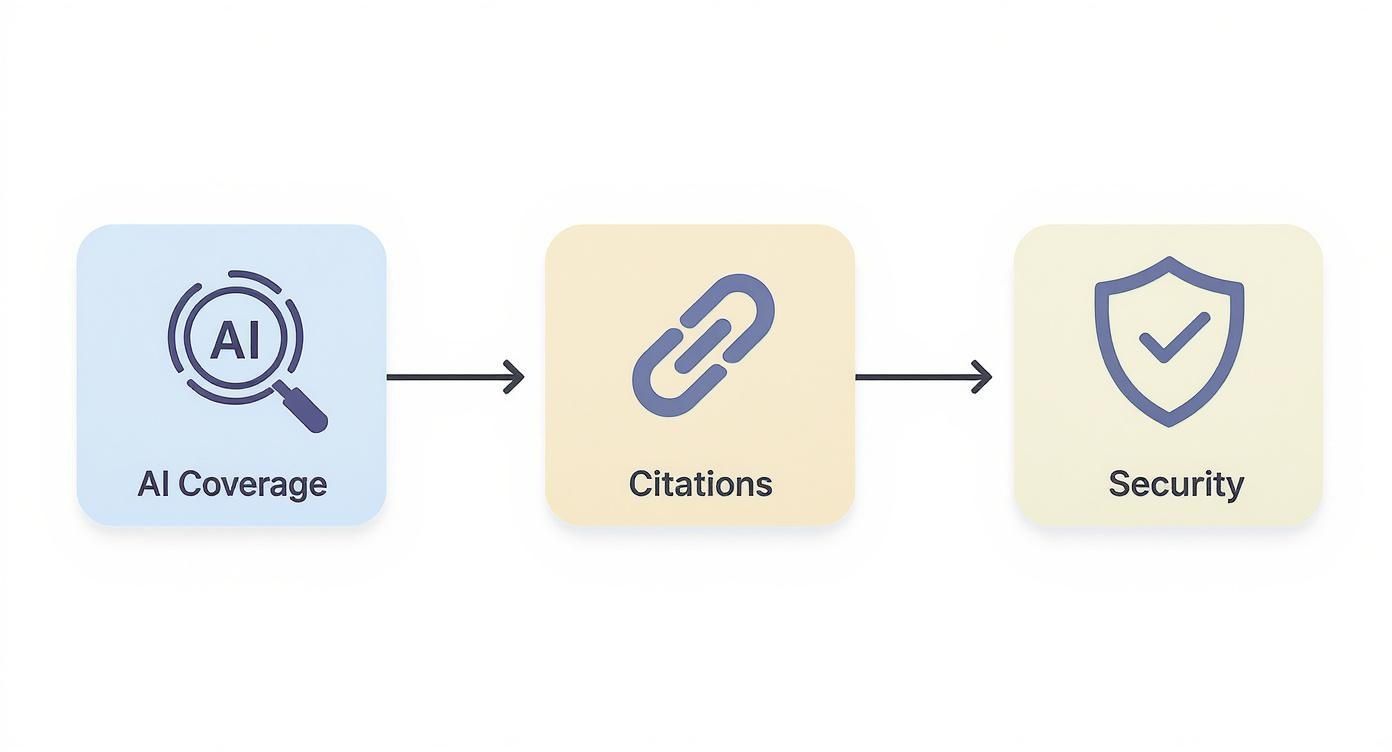
This diagram highlights how comprehensive AI coverage, verifiable citations, and robust security form the backbone of a reliable RFP response process.
Connecting Data To Downstream Workflow
Next, funnel that structured data into the tools you already use. The idea is simple: one source of truth for every next step.
- Export The Data: Download requirements, submittal registers, and compliance maps in Excel or CSV with a single click.
- Import Into Estimating Software: Feed that tidy file straight into your estimating tool so your numbers cover the full scope.
- Maintain A Single Source Of Truth: Keep the platform as your auditable record. Any question about requirements? Check the cited source.
A manual RFP response typically eats up 32 hours of your team’s time. With AI-driven automation, firms submit 46% more responses each year than those relying on spreadsheets. You can review RFP software productivity statistics.
By choosing NextBid.ai you compress a weeks-long cycle into days, freeing your best people to focus on strategy instead of paperwork. Your team can finally concentrate on the big picture.
Answering Your Questions About RFP Software
Even the most promising technology brings questions. In this section, we clear up the top concerns construction and infrastructure teams encounter when exploring RFP response software. Our goal is to give you practical, experience-backed answers so you can decide with confidence.
How Does RFP Software Handle Complex Technical Specifications And Drawings
Think of specialized RFP software as an industry veteran who’s poured over thousands of blueprints. It’s trained on real construction documents, so it doesn’t just skim text—it recognizes steel grades, load capacities, membrane types and more.
By cross-referencing your RFP, addenda and the latest CAD files, the system builds a single, unified obligation list. It’s a bit like having a senior estimator flip through every page for you, making sure no callout or note slips through the cracks.
Is Our Company’s Confidential Bid Data Secure In The Cloud
Your bid details—pricing strategy, margin targets and proprietary processes—are among your most valuable assets. Leading RFP platforms guard them like a bank vault.
Key security measures include:
- SOC 2 Compliance: Independent audits confirm your data handling matches enterprise standards.
- End-to-End Encryption: Files are encrypted the moment you upload them and stay encrypted at rest.
For a deeper look at our protocols, visit https://www.nextbid.ai/security
How Much Training Does Our Team Need To Get Started
Good RFP software hides its complexity behind a clean interface. Instead of month-long rollouts, you’ll see value in days, not weeks.
Typical onboarding covers:
- Uploading your set of drawings and spec books
- Reviewing AI-generated outputs (submittal registers, obligation sheets)
- Exporting clean data for your workflows
Most teams master the basics in 2–4 hours. Plus, dedicated success managers stick by your side through the first few bids, smoothing any bumps and shortening the learning curve.
Can This Software Integrate With Our Estimating Tools
RFP software should slot into your existing toolkit, not force you to rebuild it. Imagine it as a front-end processor that hands off ready-to-use data.
Here’s how it works:
- Export requirement lists, compliance matrices and submittal logs in Excel (.xlsx, .csv)
- Drop those files straight into your estimating, scheduling or project-management systems
- Rely on AI-verified data as the bedrock for your cost models and timelines
This approach means you maintain your preferred back-end platforms while gaining speed and accuracy at the front end.
Ready to turn a weeks-long bid cycle into a 72-hour strategic edge? NextBid.ai transforms complex RFPs into audit-proof, bid-ready evidence—so your team wins more profitable work with less stress. Explore how NextBid.ai can de-risk your next proposal