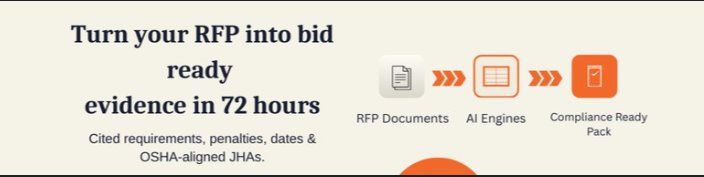
A winning construction bid proposal template is more than a document—it's your primary sales tool. It organizes your scope, pricing, and terms into a persuasive, professional offer that transforms a raw estimate into a legally sound bid. Use it to establish your competence and build client trust before the first shovel hits the dirt.
Think of it this way: a solid template is a repeatable checklist. It forces you to include every critical detail, from contract language to bonding capacity, ensuring every bid you submit is complete, competitive, and protects your business. This isn't just about looking professional; it's a direct strategy for improving your win rate.
Building a Proposal That Instills Confidence
Your proposal is the first tangible proof of your professionalism. Before a single shovel hits the ground, this document must clearly communicate your expertise, set firm expectations, and lay a foundation of trust. A well-structured bid goes way beyond just numbers; it shows the client you’ve thought through every angle of their project.
A solid template provides a consistent framework for every bid. It forces you to include the critical details that turn a simple price sheet into a formal, binding offer, like contract language, bonding references, and specific submission requirements. It’s the kind of structure that has a direct impact on RFP win rates.

Key Proposal Components
Each section of your proposal must work together to guide the client from their problem to your solution. To build a winning bid, structure your template around these four non-negotiable elements.
Component | Actionable Goal |
Cover Letter | Personalize the introduction. Address the client's main concern from the RFP directly in the first paragraph. |
Scope of Work | Define precise boundaries. Use a detailed checklist to list all deliverables, tasks, and project milestones. |
Pricing & Terms | Ensure financial clarity. Itemize costs clearly and define a payment schedule that protects your cash flow. |
Acceptance Page | Make it easy to sign. Include a clear signature line and reference the proposal number to formalize the agreement. |
Mastering this structure creates a document that both wins the job and protects your business. To learn more about the team behind these insights, you can find information about us at NextBid.ai.
Defining a Bulletproof Scope of Work
Ambiguity in construction leads directly to disputes and lost profits. A vague Scope of Work (SOW) is a primary cause of project failure, making this the most critical section of your bid proposal. Your task here is to map out every deliverable, task, and milestone with surgical precision, leaving zero room for interpretation.
This isn't just a to-do list; it’s a detailed project plan that demonstrates you've done your homework. A comprehensive understanding what is due diligence is the foundation of a strong SOW. Investing time here is your best defense against costly change orders and client disagreements later.

Master Your Exclusions and Assumptions
Stating what you won't do is as important as detailing what you will. Your exclusions list is your first line of defense against scope creep. Be explicit and thorough.
Pro Tip: If a task isn't in your scope, list it as an exclusion. Common items to specify include hazmat abatement, temporary utilities, security fencing, or specific permit fees. Never assume something is "obvious," as any gray area will be interpreted in the client's favor.
Assumptions clarify the conditions upon which your bid is based. This is especially critical for projects with unknown site conditions.
- Actionable Assumption: "This proposal assumes unrestricted site access from 7:00 AM to 5:00 PM, Monday through Friday. Any work required outside these hours will be addressed via a change order."
- Actionable Exclusion: "This scope expressly excludes the removal, handling, and disposal of any hazardous materials, including but not limited to asbestos, lead, or contaminated soils not explicitly identified in the project specifications."
This level of detail transforms your proposal from a simple quote into a legally defensible document that protects your bottom line.
Structuring Your Pricing and Payment Terms
A confusing pricing section immediately erodes trust. Whether you are bidding lump sum, unit price, or cost-plus, your goal must be total transparency. The client must be able to follow the logic from your line items to your final number.
Break down your costs into clear categories like labor, materials, equipment, subcontractor costs, and overhead. This isn't just about justifying your price; it's proof of thorough due diligence. The era of a single-number bid is over, especially as clients leverage sophisticated tools to analyze submissions. To stay competitive, you must adopt a modern approach, often facilitated by insights on construction bid management software.

Protect Your Cash Flow with Clear Terms
Your payment terms are the engine of your cash flow. Structure this section in your construction bid proposal template to ensure you are never funding the project out of your own pocket.
Tie every payment to a tangible milestone. This creates a clear, objective trigger for invoicing and ensures you get paid as work is completed.
Define the payment process with absolute clarity. Here is an actionable framework:
- Mobilization Fee: Require 10-15% upfront to cover initial material orders, site setup, and permitting costs before work begins.
- Progress Payments: Link payments to specific, verifiable milestones (e.g., "Foundation Poured," "Framing Complete"). Avoid vague monthly schedules.
- Retainage: Clearly state the retainage percentage (e.g., 5% or 10%) and the exact conditions for its release, such as "upon receipt of final lien waivers."
- Final Payment: Specify the due date, such as "Net 15 from date of final project acceptance and punch list sign-off."
Automating this process with bidding software ensures consistency and reduces errors. We built our services at NextBid.ai on this principle of transparent pricing.
Managing Project Risk and Compliance
A powerful bid proposal is your first and best risk management tool. It moves beyond scope and price to proactively address safety, scheduling, and regulatory compliance. For public works tenders, demonstrating this level of foresight is non-negotiable and proves you are a partner, not just a contractor.
Your proposal must anticipate and mitigate potential problems. Including legally sound clauses shows the client you understand the project's complexities and are prepared to manage them effectively.
Detailing Safety and Schedule Protections
A stated commitment to safety is a key differentiator. Instead of a generic sentence, take these actions:
- Reference your official corporate safety plan by name.
- State that a site-specific Job Hazard Analysis (JHA) will be completed before any high-risk activities commence.
- List key safety certifications your team holds (e.g., OSHA 30).
For an in-depth checklist on this topic, a practical guide to risk and compliance can provide valuable structure.
Likewise, protect your schedule with specific clauses that account for unforeseen events.
Every proposal must include a force majeure clause. This clause protects you from liability for delays caused by events outside your control, such as natural disasters, supply chain failures, or labor strikes. Define a clear process for submitting a formal schedule extension request.
Finally, outline your approach to regulatory adherence with specific compliance clauses.
- Regulatory Standards: State that all work will comply with current local, state, and federal building codes, including specific standards like OSHA 1926 for construction.
- Penalty Clause Example: "Contractor agrees to adhere to all stipulations outlined in permit [Permit Number]. Failure to comply, resulting in project delays or fines from the governing body, will be the sole financial responsibility of the Contractor."
This direct language builds immediate trust and demonstrates a professional, accountable approach.
Customizing and Finalizing Your Bid
Your template is the starting point, not the final product. A generic, copy-pasted bid will be ignored. To win, you must customize every proposal to directly address the client's specific Request for Proposal (RFP).
Start by creating a checklist directly from the RFP. List every submission requirement, evaluation criterion, and formatting rule. Missing a single detail is one of the fastest ways to get disqualified. Once you understand the client's priorities, tailor your proposal's narrative to match. If their primary concern is the schedule, lead with your project timeline, logistics plan, and past performance on similar deadlines.
The construction bid management market is projected to reach $10.2 billion by 2035, driven by technology that enables this precise, data-driven approach. You can review the full report on construction bid management market trends to understand the competitive landscape.
This workflow gives you a clear picture of how to manage the big-ticket risk items in your bid.
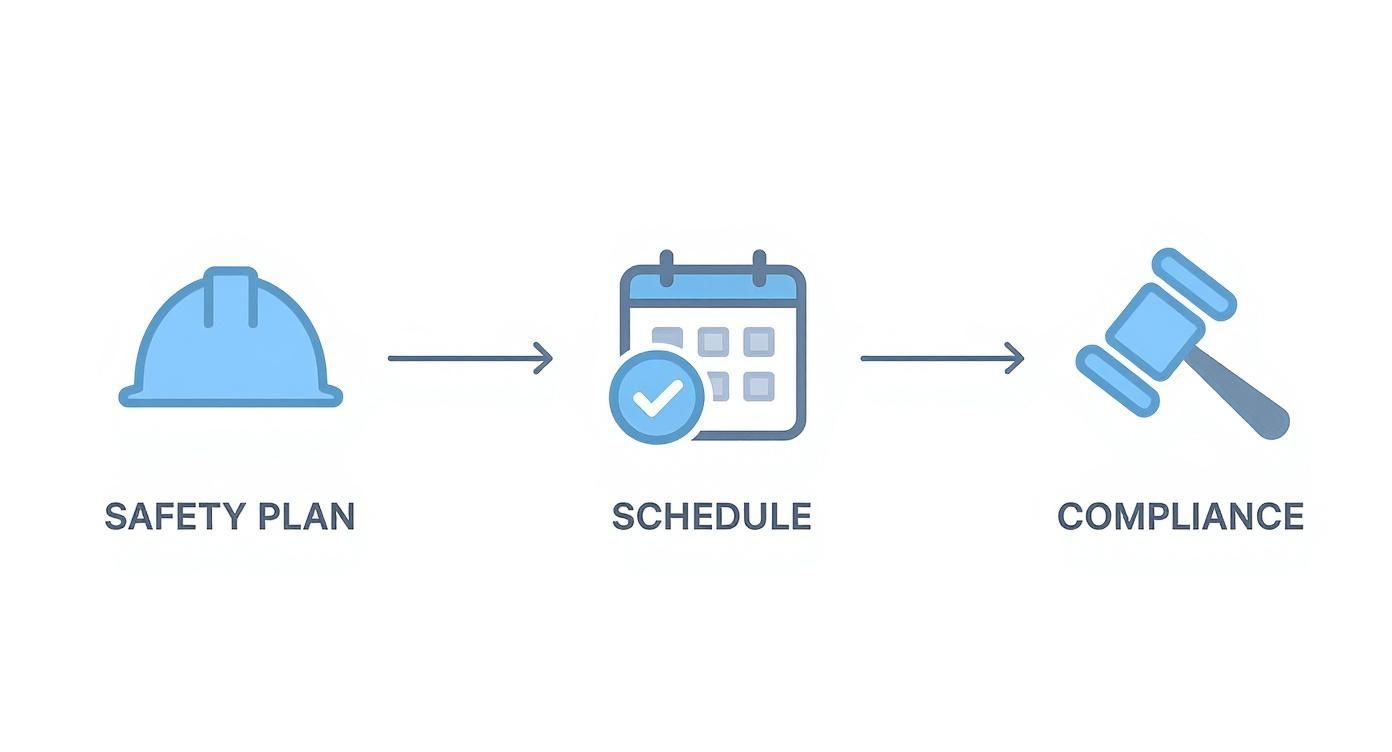
Safety, scheduling, and compliance are interconnected. Mastering them is what separates winning bids from the rest. If you need help turning a complex RFP into a submission that’s built to win, feel free to contact us at NextBid.ai.
Answering Common Bid Proposal Questions
Finalizing a bid often brings up the same practical questions. Here are clear, actionable answers to help you submit your next proposal with confidence.
How Should We Present Alternate Bids or Value Engineering?
Present value engineering (VE) options or alternate bids in a separate, clearly labeled addendum, not within the main proposal. This avoids confusion with your base bid.
For each VE option, provide a clear breakdown:
- A description of the proposed change.
- The exact cost savings or addition.
- Any impact on the project schedule or long-term performance.
This frames you as a problem-solving partner focused on the client's success.
Where Does Insurance and Bonding Information Go?
Create a dedicated section titled "Insurance & Bonding." Do not attach full certificates, as they clutter the proposal.
Instead, state your coverage limits concisely (e.g., "General Liability: 4M aggregate") and confirm that certificates of insurance and performance bonds are available upon request. This provides necessary information without overwhelming the reader.
What's the Best Way to Follow Up After Submission?
Wait at least one business day after the submission deadline has passed. Send a brief, professional email to your primary contact.
Your goal is simple confirmation and continued interest. A single sentence is often enough: "Hi [Name], I'm writing to confirm you received our proposal for the [Project Name] and are all set. We look forward to hearing from you." This keeps you top-of-mind without being intrusive.
Turn complex RFPs into audit-proof, bid-ready evidence in hours, not days. With NextBid.ai, you can extract critical requirements, generate cited JHAs, and prepare winning submissions faster. Learn more and shorten your go/no-go meetings at https://nextbid.ai.